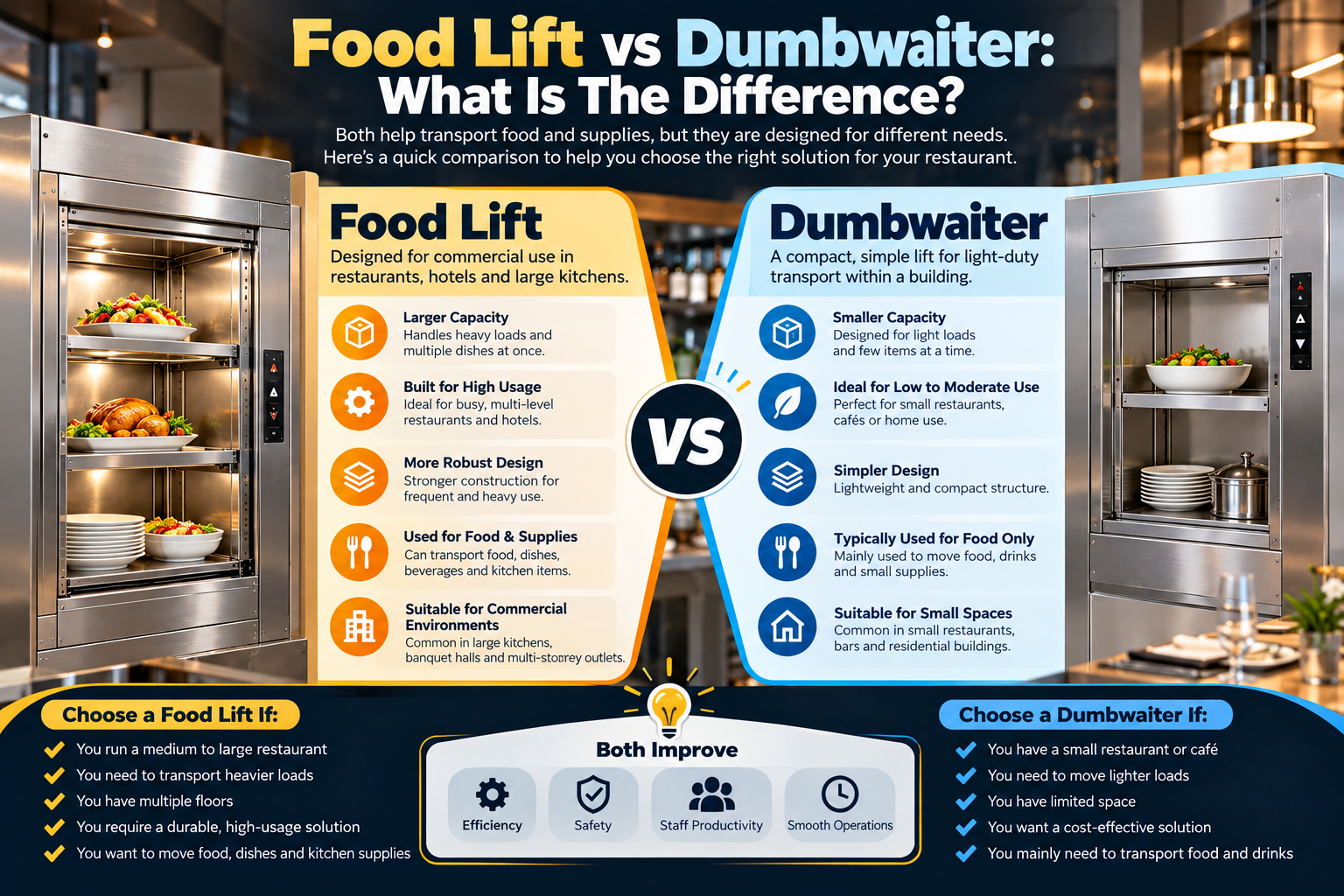
Food lift and dumbwaiter are two terms used for small lifting systems that move goods between different floor levels. In a restaurant, the equipment may carry meals, dishes, trays, containers or kitchen supplies. The terms can overlap, but they do not always describe the product in exactly the same way. Dumbwaiter usually describes the type of small goods lift, while food lift describes its food-service use. The actual equipment should therefore be selected from the required load, cabin dimensions, floor levels, available installation space and intended daily use. Looking at these practical details gives a clearer answer than comparing the names alone.
Food Lift vs Dumbwaiter: What Is the Difference?
The main difference is how the terms describe the equipment.
A dumbwaiter is a small lift intended to move goods between levels. A food lift is a similar system used specifically for food-service movement.
This means a food lift can be considered a type of application for a dumbwaiter, depending on how the manufacturer defines its product.
For example, a restaurant may need a compact lift for:
- Food containers
- Plates and dishes
- Serving trays
- Cutlery
- Kitchen supplies
- Packaged items
If the system is designed around this type of restaurant work, it may be marketed as a food lift, restaurant lift, food elevator, or restaurant dumbwaiter.
The important point is that the product name alone does not determine whether the equipment is suitable.
What Is a Food Lift?
A food lift is a compact vertical transportation system used to move suitable goods between different levels.
Its purpose is to make the movement of food-service items easier when different parts of a building are on separate floors.
A restaurant, for example, may have its kitchen on one level and its dining or serving area on another. A food lift can provide a dedicated route for moving prepared items between those levels.
Depending on the design, a food lift may be specified according to:
- Load requirement
- Cabin dimensions
- Number of stops
- Travel height
- Door arrangement
- Loading method
- Cabin finish
- Installation space
- Frequency of operation
There is no single food-lift configuration that fits every building. The equipment needs to match the actual work it will perform.
What Is a Dumbwaiter?
A dumbwaiter is a small goods lift used to move items vertically between floors.
Food and dishes are common examples, but the equipment can also be used for other suitable goods. The word itself is commonly defined as a small lift or elevator for moving food and dishes between floors.
The basic idea is simple: instead of carrying appropriate goods manually from one floor to another, the goods are placed inside a dedicated lift cabin and transported vertically.
A dumbwaiter can therefore be useful in places where regular movement of small goods takes place between levels.
The exact capacity, dimensions, controls and construction depend on the particular equipment.
Why Are Food Lift and Dumbwaiter Often Confused?
The confusion comes from overlapping use.
A restaurant might call its equipment a food lift because food is its main purpose. Another supplier may call a similar product a dumbwaiter because that describes the equipment category.
Both can refer to a compact goods-lifting system.
The terminology can also change depending on the industry, supplier and market. Terms such as food dumbwaiter, kitchen lift, food elevator and restaurant dumbwaiter may appear in product searches for closely related equipment.
That is why buyers should avoid making a purchasing decision from the name alone.
The better approach is to describe the actual requirement to the supplier.
Are a Food Lift and Dumbwaiter the Same Thing?
They can be very similar, but the terms are not necessarily interchangeable for every product.
A dumbwaiter describes what the equipment does: it moves goods between floors.
A food lift describes the intended application: it is being used for food-service movement.
The distinction becomes clearer when looking at the specification.
A system designed for restaurant use may be configured around the dimensions of trays, dishes and food containers. A different dumbwaiter could be designed for another type of small goods.
So instead of asking only:
“Is this a food lift or a dumbwaiter?”
ask:
“Is this equipment suitable for the goods, load, space and operating conditions I have?”
That question gives a much more useful basis for selection.
How Does a Food Lift or Dumbwaiter Work?
The basic operation is straightforward.
A dedicated cabin moves vertically between selected levels. Goods are loaded into the cabin, the access door is secured, and the system moves the cabin to the required floor.
The basic sequence is:
- Place the permitted goods inside the cabin.
- Make sure the total load is within the rated limit.
- Close the access door correctly.
- Operate the control system.
- Allow the cabin to reach the required level.
- Remove the goods after arrival.
The mechanical arrangement can differ from one model to another.
A system may include a drive mechanism, guide arrangement, cabin, doors, controls and safety components. The exact design should be checked against the manufacturer's specification rather than assuming all dumbwaiters use the same mechanism.
What Can a Food Lift Carry?
A food lift can carry suitable goods within its specified capacity.
Typical restaurant loads may include:
- Prepared meals
- Plates
- Trays
- Food containers
- Cutlery
- Beverages
- Kitchen supplies
- Packaged products
- Other approved goods
The maximum weight is important.
A load that physically fits inside the cabin may still be unsuitable if it exceeds the rated capacity.
The shape and size of the goods matter as well. Large trays or containers need enough cabin space for safe and practical loading.
For this reason, both weight and dimensions should be considered before selecting a model.
Can a Dumbwaiter Carry People?
A standard goods dumbwaiter is not intended to carry people.
This is an important distinction between a dumbwaiter and a passenger lift.
A person should not use a goods-only lift as a shortcut between floors. The equipment is designed around its specified goods-carrying purpose, and its controls, cabin and safety arrangements are selected accordingly.
The same principle applies to a food lift.
If people need to travel between floors, the requirement should be assessed as a passenger-lift application rather than treating a goods lift as an alternative.
What Is the Difference Between a Food Lift and a Passenger Lift?
A food lift moves goods.
A passenger lift moves people.
That difference affects the design and specification of the equipment.
A food lift generally has a compact cabin intended for items such as food containers, dishes and trays. A passenger lift is designed around human occupancy and has a different set of requirements.
Therefore, a restaurant should first identify what needs to move.
If the requirement is to transport meals and supplies between floors, a goods-lifting system may be relevant.
If staff or customers need to travel between floors, a passenger-lift solution is a different requirement.
How Do You Choose the Right Food Lift?
The right food lift should be selected from the actual operating requirement.
Start With the Maximum Load
Do not calculate the requirement using only the average load.
Think about the heaviest normal combination of trays, food containers, dishes or supplies that will be transported.
Measure the Items
Check the size of the largest items that regularly need to enter the cabin.
This is especially important for wide trays, tall containers or bulky kitchen supplies.
Check the Number of Floors
Identify every level that needs to be connected.
The number of stops and the required travel distance form part of the installation planning.
Measure the Available Space
The available shaft or installation area can affect the possible cabin size and configuration.
A suitable product on paper may not fit the actual building.
Consider Daily Usage
Think about how often the lift will operate.
A restaurant with frequent movement during busy service periods may have different equipment requirements from a facility using the lift only occasionally.
Consider Loading and Unloading
The way staff place goods into the cabin matters.
The cabin and door arrangement should work with the actual layout of the kitchen and receiving area.
Does the Food Lift Need Special Interior Materials?
The interior should suit the goods being transported and the environment in which the equipment operates.
For food-service applications, cleaning and regular maintenance are practical considerations. The selected internal surfaces should therefore be appropriate for the expected use.
The choice can depend on:
- Type of goods
- Cleaning routine
- Exposure to moisture
- Frequency of use
- Container type
- Operating environment
Stainless-steel construction is one option commonly associated with food-service equipment, but the correct specification should come from the actual application rather than an assumption that every food lift must have identical materials.
What Should You Ask a Food Lift Supplier?
Before requesting a quotation, prepare the basic information about the project.
A supplier will usually need useful details such as:
- Maximum load
- Cabin width and depth required
- Cabin height required
- Number of floors
- Approximate travel distance
- Number of stops
- Available shaft space
- Door position
- Type of goods
- Expected operating frequency
- New installation or replacement requirement
Providing this information early can make the technical discussion much clearer.
It also prevents the equipment from being selected only from a catalogue image or product name.
What Are the Most Common Selection Mistakes?
Choosing the wrong equipment often starts with incomplete information.
- Looking only at the price: A lower purchase price does not automatically mean the equipment is suitable for the intended work.
- Choosing by capacity alone: Weight is important, but cabin dimensions and building conditions matter too.
- Ignoring the largest item: A cabin may have enough load capacity but still be too small for the trays or containers that need to enter it.
- Forgetting installation space: The available shaft and landing arrangement should be checked before finalizing the equipment.
- Assuming every dumbwaiter is identical: Different products can have different capacities, dimensions, controls and construction.
- Using a goods lift for people: A goods-only system should not be treated as a passenger lift.
When Is a Food Lift Useful in a Restaurant?
A food lift becomes particularly useful when important food-service areas are separated vertically.
For example, if preparation takes place on one floor and serving takes place on another, staff may otherwise need to repeatedly carry suitable items through stairways.
A dedicated lift provides a fixed route for moving those goods.
It can help with the movement of:
- Meals
- Dishes
- Trays
- Kitchen supplies
- Containers
- Other suitable restaurant items
The value depends on the restaurant's layout and workflow. A food lift should therefore be considered as part of the building's actual movement requirements rather than simply as another piece of kitchen equipment.
Can Mr. Dumbwaiter Help With Food Lift Requirements?
Mr. Dumbwaiter provides food lift solutions and related services, with 15+ years of experience.
The company can assist with food lift requirements including installation, repair and replacement support. The correct solution depends on the intended load, cabin requirements, floor levels, available space and operating conditions.
If you are deciding between a food lift and a dumbwaiter, discussing these practical details first can make the product selection clearer.
For product requirements or technical assistance, contact Mr. Dumbwaiter at +65 67344062.
Conclusion
Food lifts and dumbwaiters are closely related, but the right choice depends on what you need to move and how the equipment will be used. A food lift is generally selected for food-service applications, while a dumbwaiter is a broader term for a small goods lift. For a restaurant or commercial kitchen, factors such as load capacity, cabin size, number of floors, available installation space and daily usage should be checked before selecting the equipment.
If you are unsure which type of lift is suitable for your building or need help with a new installation, replacement, repair or food lift requirement, Mr. Dumbwaiter can help you understand the available options based on your actual requirements. With 15+ years of experience, the team can discuss your needs and help you identify a suitable solution.
For assistance with your food lift or dumbwaiter requirement, contact Mr. Dumbwaiter at +65 67344062 and discuss your project with the team.