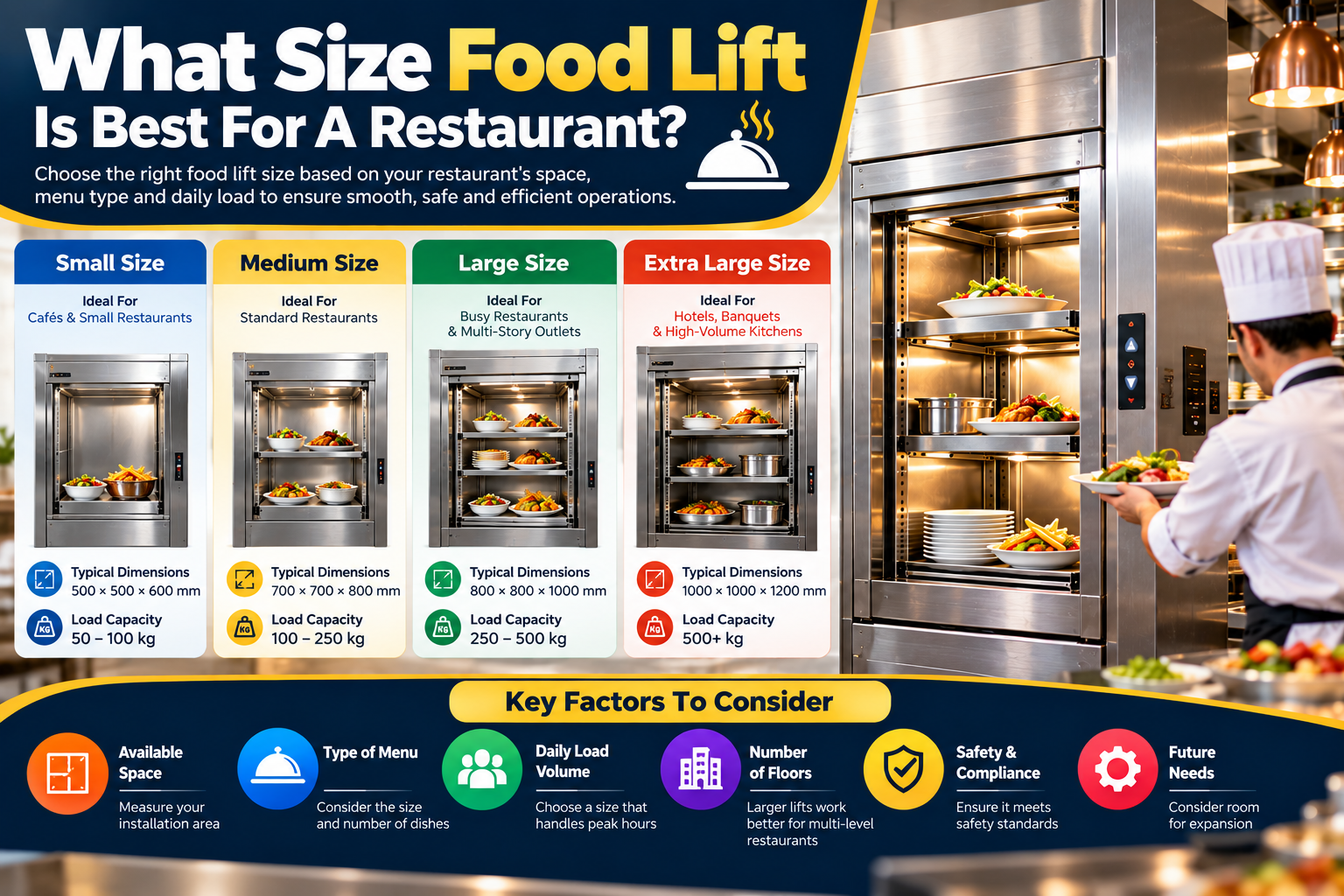
The best food lift size for a restaurant depends on what you need to transport, the weight of each load, the size of your trays or containers, and the available installation space. There is no single cabin size that works for every restaurant.
A small restaurant may only need a compact lift for plates and prepared food, while a larger kitchen may need more internal space for trays, containers, ingredients, and supplies. Choosing the size from actual daily requirements is more reliable than simply selecting the largest available model.
What Determines The Right Food Lift Size?
Four factors should be checked before selecting a food lift: load capacity, cabin dimensions, door opening, and building space.
Capacity tells you how much weight the lift can safely carry. Cabin dimensions determine whether your trays and containers can physically fit. The door opening affects whether those items can be loaded easily. Building space determines whether the selected equipment can actually be installed.
These factors should be considered together.
A lift with high weight capacity is not useful if its cabin is too narrow for the restaurant's trays. Similarly, a large cabin may not be practical if the building cannot provide the required shaft or installation space.
How Much Weight Does A Restaurant Food Lift Need?
The required capacity should come from the heaviest normal load rather than an average load.
Calculate the complete load that will enter the cabin, including the food and the containers, trays, or other items carrying it.
Consider:
- Typical load per trip
- Heaviest expected load
- Number of trays carried together
- Weight of food containers
- Ingredients or supplies transported
- Expected future requirements
For example, a kitchen that mainly sends individual plates between floors may have a very different capacity requirement from one that regularly transports several loaded food trays.
The practical answer is simple: choose a rated capacity that comfortably suits the restaurant's normal operating load without encouraging overloading.
What Cabin Dimensions Should You Look For?
Cabin size should be based on the largest items that will regularly travel inside the lift.
Measure the actual items before selecting equipment.
Check:
- Tray width
- Tray length
- Container width
- Container depth
- Container height
- Stacking height
- Number of items per trip
Do not measure only the food itself. Include the tray, container, or box that staff will actually place inside the cabin.
It is also important to check the internal cabin dimensions rather than relying only on the external size of the lift.
Why Is The Door Opening Important?
The cabin may have enough internal space, but the load still needs to pass through the door.
This is why door dimensions should be checked separately.
A restaurant using wide trays may need a different door arrangement from a kitchen transporting smaller containers. Staff should also be able to load and remove items without excessive handling.
Before ordering, compare the dimensions of the largest item with the usable door opening and internal cabin space.
This small measurement can prevent a major practical problem after installation.
Does A Restaurant Need A Large Food Lift?
Not necessarily.
A larger food lift can provide more space, but bigger does not automatically mean better. The correct size should match the restaurant's actual work.
A compact lift may be suitable when the restaurant mainly moves:
- Plates
- Small trays
- Prepared dishes
- Utensils
- Lightweight supplies
More internal space may be appropriate when the restaurant regularly transports:
- Large food trays
- Multiple containers
- Ingredient boxes
- Beverage supplies
- Heavier kitchen goods
The aim is to avoid both extremes: too small for the work or unnecessarily large for the building and operation.
How Does Restaurant Workflow Affect Lift Size?
The size decision should also consider how often the lift will be used.
A restaurant with low-volume movement may manage well with a smaller cabin and fewer trips. A busy kitchen may need more useful cabin space so staff can move larger loads efficiently.
Ask:
- How many trips are needed during peak service?
- How many items are loaded per trip?
- How far does the lift travel?
- How quickly can staff load it?
- How quickly can staff unload it?
Sometimes the problem is not simply cabin size. The restaurant may need to improve the complete movement process between the kitchen and receiving area.
What Installation Space Is Required?
The available building space can limit the size of the food lift.
Before choosing a model, check the proposed installation area and the requirements for the selected equipment.
Important measurements can include:
- Shaft or hoistway width
- Shaft or hoistway depth
- Available height
- Travel distance
- Landing space
- Door area
- Space required for installation and servicing
For a new restaurant, the lift can often be considered during the building design stage. In an existing restaurant, the available structure may place tighter limits on the possible size.
A supplier should review these measurements before the final specification is approved.
How Can You Choose The Right Food Lift Size?
A practical selection process is:
1. Measure the largest load.
Identify the largest tray, container, box, or other item that needs to travel.
2. Calculate the maximum normal weight.
Include food, containers, trays, and other items carried together.
3. Determine the number of trips.
Look at the busiest operating period rather than only average daily use.
4. Check the cabin and door dimensions.
Make sure the largest items can enter, fit, and be removed comfortably.
5. Measure the installation area.
Confirm that the building can accommodate the proposed configuration.
6. Consider future needs.
Avoid selecting a specification that is already too restrictive for realistic changes in restaurant operations.
This process gives the supplier useful information for recommending an appropriate food lift.
Common Mistakes When Choosing Food Lift Size
One common mistake is selecting equipment based only on weight capacity. The cabin may still be unsuitable for large trays or containers.
Another mistake is measuring the cabin but forgetting the door opening.
Restaurants can also underestimate peak usage. A lift that appears sufficient during quiet periods may become inconvenient when many orders need to move between floors.
Choosing the biggest available model without checking the building is another poor approach. Available space, installation requirements, and workflow should all be considered before making the decision.
Conclusion
The best food lift size for a restaurant is the size that matches its actual load, cabin requirements, door dimensions, operating frequency, and available building space.
Start by measuring the largest items and calculating the heaviest normal load. Then consider peak usage, floor-to-floor movement, installation space, and realistic future needs.
If you need help assessing these requirements, Mr.Dumbwaiter has 15+ years of experience in food lift and dumbwaiter solutions. You can contact the team at +65 67344062 to discuss your restaurant's requirements before selecting a suitable size.