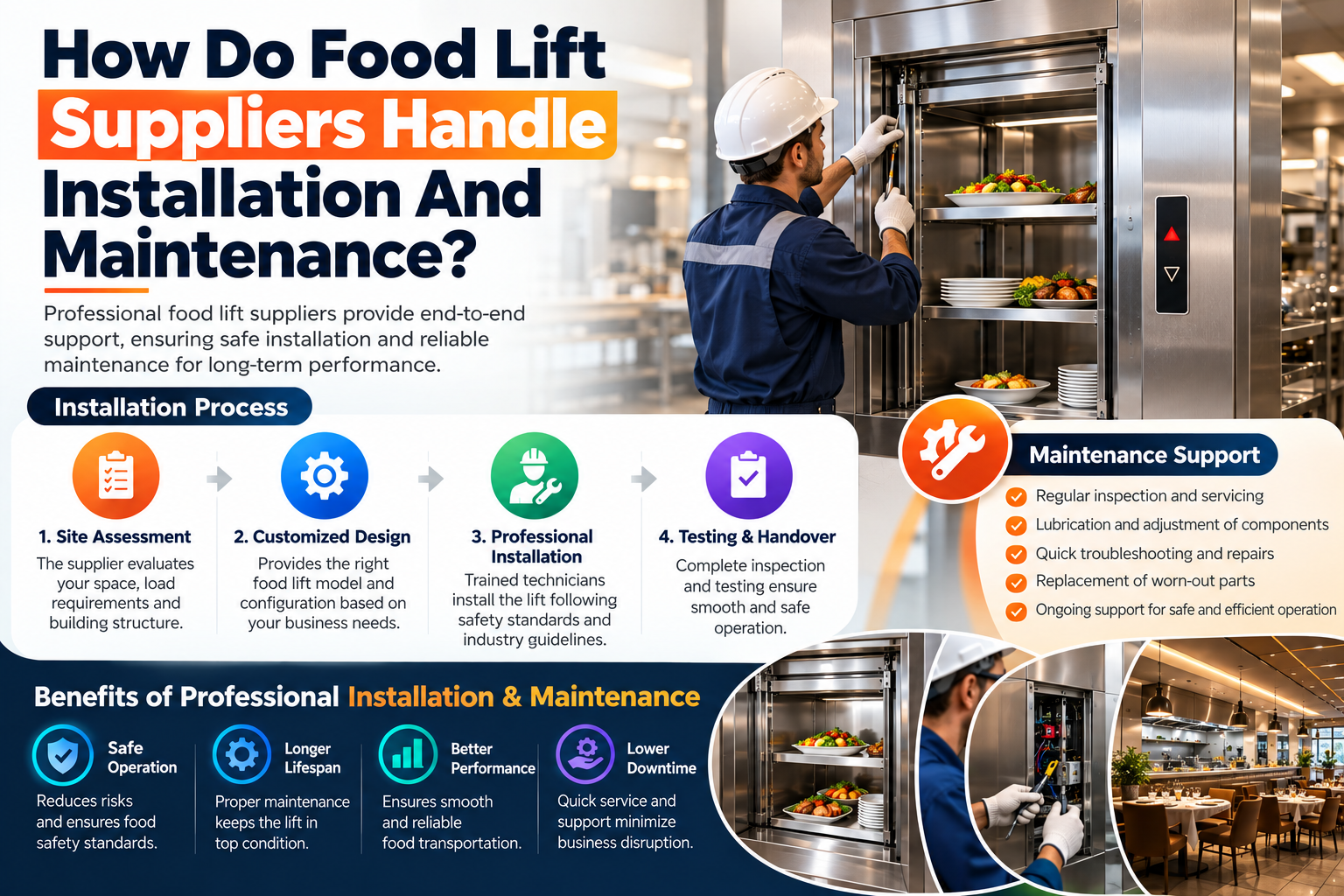
A food lift is not simply delivered and placed inside a restaurant. Proper installation, testing, regular maintenance, and timely repair all affect how safely and reliably the lift works. A professional food lift supplier normally looks at the available space, lift size, loading needs, door arrangement, electrical requirements, and installation conditions before starting the work.
Maintenance is equally important after installation. Regular inspection helps identify worn components, unusual sounds, door problems, electrical issues, and other faults before they become bigger problems. This is why choosing a supplier that can support both installation and ongoing maintenance can make food lift ownership easier for a business.
What Does A Food Lift Supplier Check Before Installation?
Before installation begins, the supplier needs to understand the site and the intended use of the food lift.
Important points can include:
- Available installation space
- Lift shaft or enclosure requirements
- Number of floors or serving levels
- Required loading capacity
- Cabin dimensions
- Door positions
- Electrical requirements
- Access for installation work
- Location of control equipment
- Expected frequency of use
These details help the supplier determine whether the selected food lift is suitable for the planned application.
A proper site assessment can also identify installation limitations before equipment is delivered. This reduces the chance of selecting a lift that does not fit the available space or operating requirements.
How Is A Food Lift Installed?
Food lift installation generally starts after the supplier confirms the equipment specifications and site conditions.
The installation team positions the main lift components according to the planned arrangement. Depending on the system, this may involve the lift cabin, guide components, doors, drive equipment, controls, safety components, and related electrical connections.
The exact installation process depends on the food lift design and building conditions.
A professional installation should focus on correct positioning, secure connections, proper alignment, door operation, control functionality, and safe movement of the lift.
Installation should not be treated as a simple delivery service. Small alignment or connection problems can affect the way a lift operates later.
Why Is Proper Food Lift Installation Important?
Correct installation affects the daily operation of the equipment.
A properly installed food lift should move smoothly between its serving levels, operate its doors correctly, respond properly to controls, and function according to its intended design.
Poor installation can create problems such as:
- Unusual movement
- Door alignment issues
- Excessive operating noise
- Repeated breakdowns
- Control problems
- Uneven operation
- Premature component wear
Professional installation therefore provides the foundation for future maintenance and reliable use.
What Happens After Food Lift Installation?
A supplier should not simply finish the physical installation and leave the equipment without checking its operation.
Post-installation checks can include testing the lift movement, controls, doors, safety functions, stopping positions, and other operating components.
The supplier may also check whether the lift responds correctly at each serving level and whether the equipment operates according to the agreed specifications.
Testing is important because installation problems are easier to correct immediately than after the equipment has been used for a long period.
How Do Food Lift Suppliers Handle Maintenance?
Food lift maintenance is focused on keeping the equipment in proper working condition and identifying developing problems early.
A maintenance service may include inspection of:
- Lift doors
- Door locks and related mechanisms
- Guide components
- Drive system
- Electrical connections
- Control panel
- Safety components
- Cabin movement
- Operating switches
- Visible wear on important components
The exact maintenance checklist depends on the food lift model, usage level, installation arrangement, and manufacturer requirements.
Regular maintenance should be based on the equipment's actual condition rather than waiting until the lift stops working.
How Often Should A Food Lift Be Maintained?
There is no single maintenance interval that applies to every food lift.
The appropriate schedule can depend on factors such as how frequently the lift is used, its operating environment, equipment design, manufacturer recommendations, and the condition of its components.
A food lift used heavily throughout the day may need closer attention than equipment used occasionally.
The supplier can assess the equipment and recommend a maintenance schedule based on its operating conditions.
What Does A Food Lift Maintenance Visit Include?
A maintenance visit should involve more than a quick visual check.
The service team may inspect important operating components, test the lift's movement, check doors and controls, look for signs of wear, and identify issues that could affect future operation.
If a component shows signs of deterioration, the supplier can advise whether adjustment, repair, replacement, or further inspection is appropriate.
Good maintenance is about finding problems early rather than waiting for a complete breakdown.
Why Should Food Lift Doors Be Checked Regularly?
Food lift doors are used every time goods are loaded or removed from the cabin. Because of this repeated use, door condition is an important part of routine maintenance.
The supplier may check door alignment, locking operation, movement, and related components.
A door that does not operate correctly should not be ignored. It can affect the normal operation of the lift and may indicate that adjustment or repair is needed.
Regular door inspection can help identify these problems before they interrupt daily business operations.
What Signs Show That A Food Lift Needs Maintenance?
Some problems are easy to notice during everyday use.
Businesses should pay attention to:
- Unusual sounds
- Jerky movement
- Slow or inconsistent operation
- Door problems
- Unusual vibration
- Control response problems
- The lift stopping unexpectedly
- Repeated operating faults
A change from normal operation is worth checking.
Waiting until the food lift completely stops can turn a smaller maintenance issue into a more expensive repair or cause unnecessary disruption to restaurant operations.
How Do Suppliers Handle Food Lift Repairs?
When a food lift develops a fault, the supplier can inspect the equipment to identify the cause before recommending a repair.
The repair process may involve checking the electrical system, controls, doors, drive components, safety parts, or other equipment connected to the reported problem.
The correct repair depends on the actual fault.
A reliable supplier should explain what needs attention instead of recommending unnecessary work. If a component can be repaired safely, repair may be appropriate. If a component is severely worn or no longer suitable, replacement may be considered.
When Does A Food Lift Need Replacement Instead Of Repair?
Repair is not always the best long-term answer.
Replacement may need to be considered when equipment has extensive wear, repeated faults, outdated components, or damage that makes continued repair impractical.
The decision should be based on the equipment's condition, operating requirements, repair history, availability of suitable components, and the expected value of continued use.
A supplier can inspect the existing food lift and explain whether repair, replacement, or an upgrade is more suitable.
Why Is Preventive Maintenance Better Than Waiting For A Breakdown?
Reactive repair happens after a problem has already affected the equipment.
Preventive maintenance takes a different approach by checking important components before a major failure occurs.
This can help businesses:
- Identify developing faults earlier
- Reduce unexpected downtime
- Keep equipment operating consistently
- Monitor component wear
- Plan repairs more effectively
- Avoid unnecessary emergency service situations
Maintenance cannot guarantee that a food lift will never develop a fault, but regular checks can help businesses manage equipment problems more effectively.
What Should A Business Ask A Food Lift Supplier About Maintenance?
Before choosing a supplier, ask clear questions about ongoing support.
Useful questions include:
- Do you provide food lift maintenance?
- What does a maintenance visit include?
- Can you inspect an existing food lift?
- Do you provide repair services?
- Can worn components be replaced?
- Do you support food lift upgrades?
- How are maintenance issues reported?
- Can you recommend a maintenance schedule?
- Do you provide installation and after-sales support?
These questions help a business understand what support will be available after the initial purchase.
Why Is It Better To Choose One Supplier For Installation And Maintenance?
Using one experienced supplier for installation and ongoing maintenance can make equipment management simpler.
The same supplier can understand the original installation arrangement, equipment specifications, operating requirements, and previous service history.
This can make it easier to identify changes in performance and determine what may need attention.
It also gives the business one point of contact for supply, installation, maintenance, repair, replacement, and related service requirements.
How Does Supplier Experience Affect Food Lift Installation?
Experience matters because every installation has its own requirements.
A supplier with practical experience can assess the available space, understand the intended application, identify installation concerns, and recommend equipment based on the actual requirement.
Experience also becomes useful when an existing food lift develops a problem. Instead of treating every fault as a completely new situation, an experienced service team can inspect the equipment systematically and determine the appropriate next step.
Why Choose Mr.Dumbwaiter For Food Lift Installation And Maintenance?
Mr.Dumbwaiter provides food lift support with 15+ years of experience in the industry.
The company focuses on more than supplying equipment. Its support can cover important stages of the food lift lifecycle, including supply, installation, maintenance, repair, replacement, and related service requirements.
For a business, this creates a more practical relationship with the supplier. The goal is not simply to complete one installation and end the relationship. Ongoing communication and service support matter because food lifts remain part of the daily working environment.
Mr.Dumbwaiter focuses on understanding the requirement, providing suitable support, and maintaining a long-term relationship with customers.
What Makes A Good Food Lift Installation And Maintenance Partner?
A good supplier should provide clear communication from the beginning.
The business should know what equipment is being supplied, what installation work is required, what maintenance involves, and how future service requirements will be handled.
A dependable working relationship is built through:
- Clear communication
- Proper requirement assessment
- Careful installation
- Practical maintenance support
- Honest repair recommendations
- Timely attention to equipment problems
- Long-term customer support
These points are often more important than simply choosing a supplier based on the lowest initial price.
How Can A Business Reduce Food Lift Maintenance Problems?
Businesses can help maintain their food lift by using it according to its intended purpose and loading limits.
Staff should avoid overloading the cabin, forcing doors, or using damaged controls. Any unusual sound, movement, or operating problem should be reported instead of ignored.
Keeping the lift area clean and accessible can also make routine inspection easier.
Most importantly, scheduled professional maintenance should not be skipped simply because the lift is still operating.
What Should You Consider Before Hiring A Food Lift Supplier?
Before making a final decision, consider the complete service relationship rather than only the equipment price.
Check whether the supplier understands your application, provides suitable installation support, offers maintenance, handles repairs, and can assist if the equipment eventually requires replacement or upgrading.
Also check whether the supplier communicates clearly about the scope of work and the services included in the quotation.
A supplier that can support the equipment beyond the initial installation can provide greater continuity for a business.
Contact Mr.Dumbwaiter For Food Lift Installation And Maintenance
If your business needs a food lift, the right starting point is to discuss the actual requirement before selecting the equipment.
Mr.Dumbwaiter can assist with food lift supply, installation, maintenance, repair, replacement, and related service needs. With 15+ years of experience, the focus is on providing practical support and building a long-term relationship with customers.
For your food lift requirement, contact Mr.Dumbwaiter at +65 67344062 and discuss the installation or maintenance to support your business needs.
Conclusion
Food lift installation and maintenance are connected parts of the equipment's working life. Proper installation creates the right starting point, while regular maintenance helps identify wear and operating problems before they become larger issues.
A supplier that provides installation, maintenance, repair, replacement, and ongoing support can make food lift management easier for a business.
Before choosing a supplier, look beyond the initial equipment price. Check the supplier's experience, installation process, maintenance support, repair capability, communication, and commitment to long-term customer service.
For businesses looking for complete food lift support, Mr.Dumbwaiter brings 15+ years of experience with a focus on supply, installation, maintenance, repair, replacement, and lasting customer relationships.