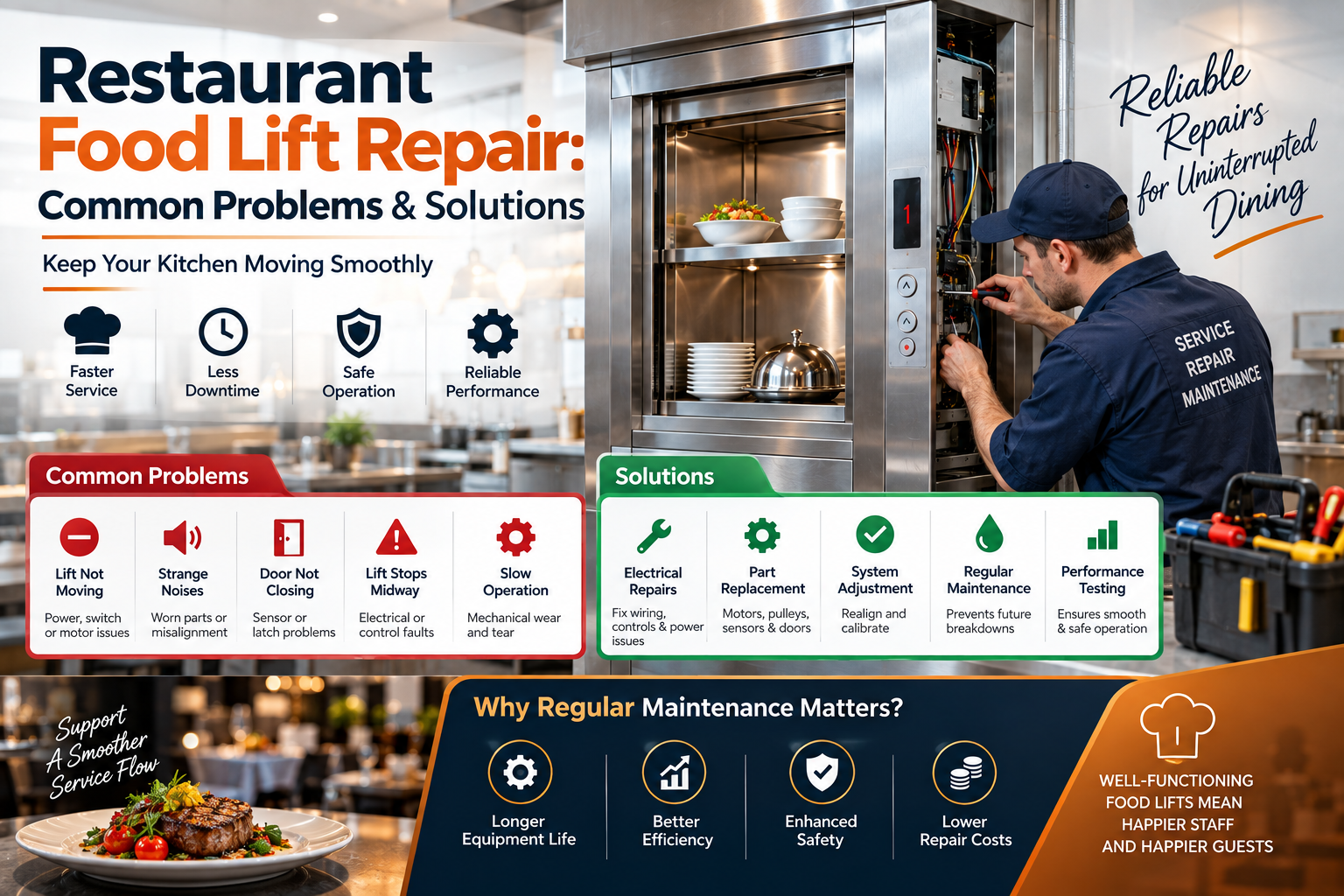
Restaurant Food Lift Repair: Common Problems & Solutions
A restaurant food lift is used to move food, dishes, utensils, kitchen supplies, and other goods between floors. When it stops working, moves unevenly, makes unusual sounds, or develops a door problem, even a small fault can interrupt normal restaurant work.
MR. DUMBWAITER provides restaurant food lift repair support with 15+ years of experience. Our commitment is to check the actual condition of the lift, identify the source of the problem, and recommend the repair that is appropriate for the equipment. We do not treat every fault as the same because the cause can be electrical, mechanical, control-related, or connected to the doors and safety system.
If your food lift is not operating properly, call +65 67344062 to discuss the problem with our team.
What Is a Restaurant Food Lift?
A restaurant food lift is a small goods lift used to move items between different floors of a restaurant, hotel, kitchen, or commercial building. It can reduce the need for staff to carry trays, dishes, food supplies, and other goods manually between levels.
Depending on the installation, a food lift can have a lift car, landing doors, guide rails, motor or drive equipment, controls, limit switches, door interlocks, and other safety components. The exact arrangement varies according to the lift design, capacity, travel distance, and installation.
A common question is whether a restaurant food lift is the same as a passenger lift. It is not. A food lift or dumbwaiter is designed for goods, not people. Staff should never ride inside a goods lift unless the equipment is specifically designed and approved for that purpose.
Restaurant kitchens also create a demanding environment for equipment. Heat, grease, moisture, food particles, frequent cleaning, and heavy daily use can affect doors, controls, moving components, and other parts over time.
What Are the Most Common Restaurant Food Lift Problems?
The symptoms can look similar even when the actual causes are different. A food lift that does not move, for example, may have a door interlock issue, electrical fault, control problem, or another condition preventing operation.
Common restaurant food lift problems include:
- The lift does not start.
- The lift does not move up or down.
- The lift stops between floors.
- The doors do not close correctly.
- The doors are difficult to open.
- The lift makes grinding, rattling, clicking, or unusual sounds.
- The lift moves slowly or unevenly.
- The lift shakes during travel.
- The lift does not stop correctly at a floor.
- Call buttons do not respond.
- Controls show a fault or stop responding.
- The lift works for a while and then stops.
- The same fault keeps coming back after a reset.
Why does this matter? A lift problem should not be judged only by whether the lift starts again. If a fault keeps returning, there may be an underlying problem that still needs attention.
A temporary reset can sometimes restore operation, but it does not necessarily fix the reason the fault occurred.
Why Is My Restaurant Food Lift Not Working?
There is no single reason why a restaurant food lift stops working. The fault can be related to the electrical supply, controls, doors, safety circuit, motor, drive equipment, or mechanical components.
One common reason is a door or interlock problem. The lift is normally prevented from travelling when a required door is not properly closed or locked. Grease, dirt, wear, misalignment, or a damaged component can affect the door system.
Electrical problems can also stop the lift. These may involve the power supply, protective devices, wiring, control components, switches, or other electrical equipment.
What if the lift was working normally and suddenly stopped? The change itself is useful information. Staff should note what happened immediately before the fault. For example, did the lift make a noise, stop at a particular floor, become slow, show an indicator fault, or fail after repeated use?
Motor, brake, drive, position-sensing, or mechanical problems can also cause a lift to stop or operate abnormally.
The important point is that repeatedly pressing the button or resetting the system does not identify the cause. If the problem continues, the equipment should be inspected by a qualified technician.
Restaurant Lift Common Problems and Their Solutions
Food Lift Is Not Starting
If the lift does nothing when a button is pressed, check whether the normal operating conditions are present. For example, doors may need to be fully closed before the lift can receive a travel command.
If the doors appear normal but the lift still does not start, the problem may be within the control circuit, electrical supply, motor, safety circuit, or another component.
Staff should not open electrical panels or attempt to bypass a safety device. The correct repair depends on the fault found during inspection.
Food Lift Stops Between Floors
What should you do if the food lift stops between floors?
Do not try to pull, push, or manually force the lift car to another floor. Do not attempt to open restricted access areas to reach the car.
A mid-travel stop can have several causes, including a control fault, position or limit issue, motor or drive problem, safety circuit activation, or a mechanical obstruction. The lift should be taken out of normal use until the cause has been checked.
A technician can determine where the system stopped, inspect the relevant components, and establish why the lift did not complete its travel.
Food Lift Door Is Not Closing Properly
A door problem can prevent the entire lift from operating. This is not necessarily a sign that the motor has failed.
Why does a door problem stop the lift? The door system is connected to the safety circuit. The lift should not be allowed to travel when a required door is not properly secured.
Grease, food residue, dirt, misalignment, worn hardware, or a faulty interlock can affect door operation. A door that needs to be pushed, pulled, or held in a certain position to make the lift run should not be treated as normal operation.
Never bypass or defeat a door interlock to keep the lift running. Interlocks are safety components, not optional operating switches.
Food Lift Makes Unusual Sounds
What does a strange noise from a food lift mean?
The answer depends on the type of sound and when it occurs. Grinding, scraping, rattling, clicking, or repeated knocking can point to wear, loose components, guide or bearing problems, drive issues, or another mechanical condition.
A noise that appears only when the lift moves upward may point to a different area than a noise heard during stopping or door operation.
Do not ignore a new sound simply because the lift is still moving. Early inspection can identify a developing problem before it causes a complete breakdown.
Food Lift Moves Slowly or Unevenly
A food lift that has become slower than normal should be checked rather than accepted as normal ageing.
Uneven or jerky movement can be associated with mechanical wear, guide problems, drive or motor issues, control faults, or other conditions affecting the movement of the lift.
If the lift used to move smoothly and has gradually changed, that change is useful evidence. Staff should report when the problem started and whether it occurs on every floor or only during particular movements.
Food Lift Does Not Stop Correctly at a Floor
Why does a food lift stop above or below its normal position?
Possible causes include a position-sensing problem, limit or control issue, mechanical wear, or another fault affecting stopping accuracy.
Incorrect stopping can make loading and unloading more difficult and may create a trip or handling concern around the landing area.
The lift should be inspected rather than repeatedly adjusted by unqualified staff. The correct setting depends on the equipment design and its control and stopping system.
Food Lift Buttons Are Not Responding
A call button that does not respond may have a problem with the button itself, wiring, control equipment, power supply, or another part of the control circuit.
If one button fails while the others continue to work, the fault may be local to that control point. If several buttons stop responding together, the problem may be further within the control system.
Do not assume that a failed button means the complete lift needs replacement. Proper testing can identify whether the problem is limited to a control component or part of a larger fault.
How Does Food Lift Troubleshooting Work?
Food Lift Troubleshooting should begin with the actual symptom rather than immediately replacing a component.
A technician will normally want to know:
- What exactly is the lift doing?
- Does it fail every time or only sometimes?
- Does the problem occur on one floor or several floors?
- Does the lift make an unusual sound?
- Do the doors close and lock normally?
- Did the problem appear suddenly or gradually?
- Does the lift stop at a particular point?
- Are there any visible fault indications?
These details can help narrow down the affected system.
Basic user-level checks can include confirming that the doors are properly closed and that there is no obvious obstruction around the normal loading area. Anything involving electrical panels, restricted lift areas, safety circuits, hoisting equipment, or internal mechanical parts should be handled by qualified personnel.
For example, a lift that does not move may appear to have a motor problem, but the actual cause could be a door interlock that has not proved closed. Technical troubleshooting separates the symptom from the actual fault.
This approach matters because replacing the wrong component can leave the original problem unresolved.
When Does a Restaurant Food Lift Need Professional Repair?
A restaurant food lift needs professional attention when the equipment no longer operates as it normally should, particularly when the problem involves movement, doors, controls, safety devices, or repeated breakdowns.
Professional repair should be considered when:
- The lift repeatedly stops.
- The lift stops between floors.
- A door does not close or lock correctly.
- The lift moves with unusual noise or vibration.
- The lift has become noticeably slower.
- The lift does not stop correctly at a landing.
- Buttons or controls stop responding.
- A safety device appears to be faulty.
- An electrical protection device repeatedly trips.
- The same fault returns after a reset.
- There is a burning smell or visible sign of electrical damage.
What if the lift starts working again after being switched off and restarted? That does not necessarily mean the problem is gone. A recurring fault can be a sign of an underlying electrical, control, thermal, mechanical, or safety-related issue.
If the equipment behaves differently from normal operation, it is better to have the cause checked than to wait for a complete breakdown.
MR. DUMBWAITER has 15+ years of experience in lift-related services and is committed to handling repair requirements with proper attention to the condition of the equipment. For assistance, call +65 67344062.
What Is Included in a Restaurant Food Lift Repair Service?
A Restaurant Food Lift Repair Service starts with identifying the reported problem and checking the equipment affected by that problem.
Depending on the lift and fault, repair work may include:
- Checking the reported operating symptoms.
- Inspecting the electrical supply and controls.
- Checking call buttons and control points.
- Inspecting doors and interlocks.
- Checking motor and drive equipment.
- Inspecting relevant mechanical components.
- Checking movement and stopping performance.
- Identifying worn, damaged, or failed parts.
- Repairing or replacing components where required.
- Testing the lift after repair.
- Confirming that the reported problem has been addressed.
Does every repair require a replacement part? No. Some faults may involve adjustment, cleaning, alignment, or another service action. Other problems may require a component to be repaired or replaced.
The correct work depends on what the inspection finds. A responsible repair process should not recommend unnecessary replacement simply because a lift has stopped working.
At MR. DUMBWAITER, our commitment is to understand the problem first and then provide a repair solution based on the actual condition of the lift.
How Can Food Lift Maintenance Prevent Breakdowns?
Food Lift Maintenance helps identify wear and developing faults before they cause major operating problems.
Restaurant food lifts deserve particular attention because they can operate in environments where grease, moisture, food particles, heat, and frequent cleaning are present. These conditions can affect doors, controls, mechanical components, and other equipment.
Maintenance can include checks of:
- Door operation and interlocks
- Control buttons and control equipment
- Electrical components
- Motor and drive equipment
- Guide and moving components
- Safety devices
- Stopping and positioning
- Unusual sounds and vibration
- General condition and cleanliness
What should restaurant staff do between professional maintenance visits?
Staff can report changes in operation instead of waiting for a complete failure. A new noise, slow movement, repeated stopping, door problem, or unusual vibration should be reported.
The lift should also be operated within its rated capacity. Overloading can put additional strain on the equipment and may contribute to premature wear.
Maintenance cannot prevent every possible breakdown, but regular attention can help identify problems earlier and keep the equipment in suitable working condition.
Can a Restaurant Food Lift Be Repaired Instead of Replaced?
A faulty food lift does not automatically need complete replacement.
Whether repair is suitable depends on the age, condition, design, availability of parts, safety condition, history of breakdowns, and extent of damage.
For example, a lift may remain in good overall condition while one door component, control component, switch, or mechanical part has failed. In that situation, repairing or replacing the affected component may be appropriate.
But what if the lift has repeated faults?
Repeated repairs can indicate that the equipment has wider wear or that several major components are approaching the end of their useful service life. In such cases, the cost and practicality of continued repairs should be considered against upgrading or replacement.
The right decision should be based on inspection rather than assumption.
MR. DUMBWAITER can assess the condition of the equipment and discuss whether repair, component replacement, upgrading, or replacement should be considered for the particular lift.
How Much Does Restaurant Food Lift Repair Cost?
The cost of restaurant food lift repair depends on the actual fault. There is no single price that applies to every food lift.
Several factors can affect the repair cost:
- Type of fault
- Lift design and model
- Component affected
- Parts required
- Labour involved
- Accessibility of the equipment
- Extent of damage
- Age and condition of the lift
- Testing required after repair
Why can a repair price not always be given from a phone call?
Because the same symptom can have different causes. For example, a lift that does not move may have a door interlock issue, control fault, electrical problem, motor issue, or another condition. Each requires different work.
An inspection gives the technician a better understanding of the actual problem and the parts or service required.
MR. DUMBWAITER is committed to giving customers a clear understanding of the required repair based on the condition of the equipment. For restaurant food lift repair assistance, call +65 67344062.