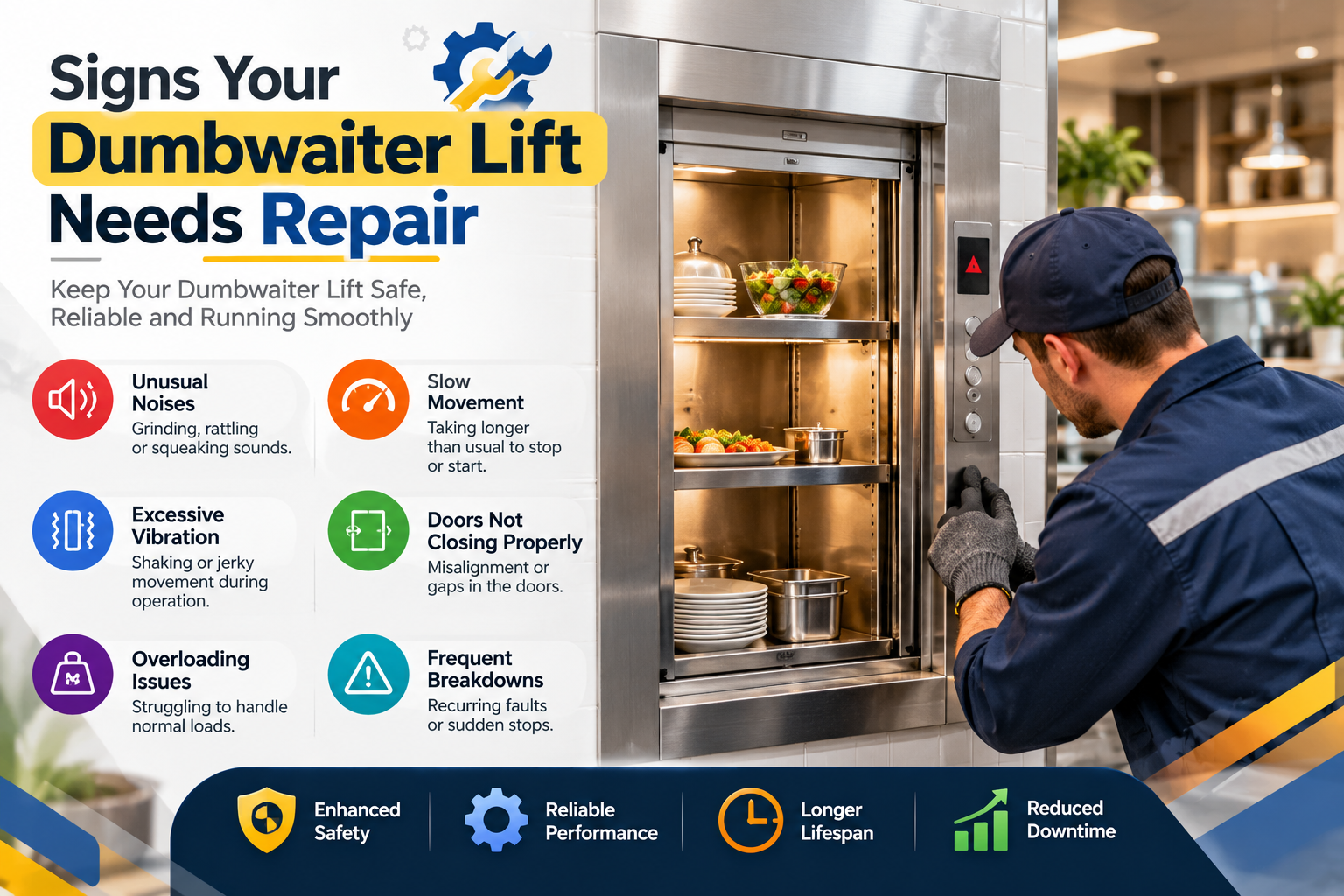
A dumbwaiter lift usually gives clear warning signs before a small fault becomes a major breakdown. Unusual noise, slow movement, door problems, sudden stops, uneven stopping, or repeated control errors can all indicate that the system needs inspection or repair.
Ignoring these signs can lead to longer downtime, damaged components, and avoidable safety problems. Regular maintenance and timely repair help keep the lift operating smoothly and can extend the useful life of important parts.
Unusual Grinding, Scraping, or Clicking Noises
A change in the normal sound of a dumbwaiter is one of the easiest warning signs to notice.
Grinding, scraping, knocking, or repeated clicking may point to problems with moving components, guide systems, the motor, gearbox, or loose parts. Debris or poor lubrication can also affect smooth movement.
Do not assume that a new noise will disappear on its own. A technician should inspect the system and identify the source before continued operation causes additional wear.
The Dumbwaiter Is Moving More Slowly
A noticeable reduction in lifting speed can indicate that something is no longer working as it should.
Possible causes can include:
- Motor wear
- Drive or transmission problems
- Brake-related issues
- Worn cables, belts, or other drive components
- Electrical or control faults
- Increased friction in the moving system
A gradual change can be easy to overlook because the lift may still complete its normal movement. However, a consistent performance change is useful information for a technician and should be checked rather than ignored.
The Lift Moves Unevenly or Jerks During Travel
A properly functioning dumbwaiter should move in a controlled and predictable way.
Jerking, shaking, sudden acceleration, vibration, or inconsistent movement can indicate a mechanical, electrical, or drive-system problem. The exact cause depends on the design of the lift and the component involved.
This is particularly important when the problem appears suddenly or becomes more frequent. Continuing to operate equipment with abnormal movement may increase wear on other components.
Doors Are Difficult to Open, Close, or Lock
Door problems should be treated seriously because dumbwaiter doors are part of the lift's safety system.
Warning signs include:
- A door sticks while opening or closing
- The door does not close completely
- The door does not latch correctly
- The lift operates only after the door is pushed into position
- The lift refuses to operate because a door sensor or interlock is not registering correctly
Safety interlocks are designed to prevent operation when the required door condition is not met. They should never be bypassed simply to keep the lift running.
The Dumbwaiter Stops Between Floors
A dumbwaiter stopping unexpectedly between floors is a strong reason to stop normal use and arrange a professional inspection.
The cause could involve a limit switch, control system, motor, brake, obstruction, or another mechanical component. The fault cannot be identified safely just by looking at the lift from outside.
Do not try to force the car up or down manually. Incorrect handling can create additional mechanical damage and may increase the risk of injury.
The Lift Is Not Stopping Level With the Landing
The dumbwaiter should normally stop at the intended position so that the loading area can be accessed safely.
If the platform or car consistently stops noticeably above or below the landing, the problem may involve the drive, brake, limit or position-related components. Levelling problems can also make it harder to load or remove goods safely.
A new or worsening levelling issue should therefore be inspected instead of being treated as a minor inconvenience.
Buttons, Controls, or Error Messages Are Not Working Normally
Electrical and control problems can appear in several ways.
You may notice:
- A call button does not respond
- Controls work intermittently
- The lift starts and stops unexpectedly
- An error code appears
- The control panel behaves differently from normal
- The lift repeatedly requires a reset
Modern dumbwaiter systems can contain control boards, sensors, switches, and other electrical components. Moisture, loose connections, component failure, and other faults can affect these systems.
If an error keeps returning after a reset, the underlying problem should be investigated instead of repeatedly restarting the equipment.
The Motor or Equipment Shows Signs of Overheating
Unusual heat, a burning smell, or repeated motor shutdowns should not be ignored.
An overheating motor can be associated with excessive load, electrical faults, mechanical resistance, poor ventilation, or component wear. The correct diagnosis requires inspection of the complete system.
If there is a burning smell, smoke, visible electrical damage, or another immediate safety concern, stop using the dumbwaiter and arrange professional assistance.
Repairs Are Becoming More Frequent
One repair does not necessarily mean that a dumbwaiter needs major replacement. However, repeated faults can indicate that several components are wearing out or that an underlying problem has not been properly resolved.
Keep a simple record of:
- What failed
- When the problem occurred
- Any error codes
- Unusual sounds or movement
- Parts that were repaired or replaced
- How often the fault returns
This information can help a technician identify patterns instead of treating every breakdown as an isolated event.
What Should You Do When You Notice These Signs?
The safest approach is to avoid guessing which component has failed.
First, note exactly what changed. Then, if the problem affects movement, doors, levelling, controls, or safety functions, arrange an inspection by a qualified technician familiar with dumbwaiter systems.
A proper inspection may involve checking the motor, cables or belts, guides, doors, interlocks, switches, controls, safety devices, alignment, and other relevant components. Maintenance providers commonly use inspection, diagnosis, adjustment, lubrication, electrical checks, and functional testing as part of dumbwaiter servicing.
The goal is not simply to make the lift move again. The cause of the fault should be identified so the same problem does not continue.
Repair or Replacement: Which One Is Needed?
Repair is often appropriate when a specific component can be safely restored or replaced. Replacement or modernization may need consideration when equipment is heavily worn, parts are no longer practical to maintain, or recurring faults involve major components.
The decision depends on the lift's age, condition, design, usage, available replacement parts, safety condition, and the nature of the fault.
A professional assessment is more useful than deciding based only on the age of the dumbwaiter.
How Mr.Dumbwaiter Can Help With Dumbwaiter Repair
Mr.Dumbwaiter provides dumbwaiter repair and technical support for problems including electrical faults, motor issues, cable replacement, and safety-related problems. The company also provides maintenance, spare parts, installation, and upgrade services.
With 15+ years of experience, Mr.Dumbwaiter can assess the reported problem and help identify the appropriate repair or maintenance requirement.
If your dumbwaiter is making unusual sounds, moving differently, stopping unexpectedly, or showing repeated faults, you can contact Mr.Dumbwaiter at +65 67344062 to discuss the issue and determine the next practical step.
Conclusion
The main signs that a dumbwaiter lift may need repair include unusual noises, slow or jerky movement, door problems, unexpected stops, poor levelling, control faults, overheating, and repeated breakdowns.
The practical point is simple: do not wait for a complete failure when the equipment is already showing changes in performance. Early inspection can help identify worn or faulty components before the problem develops into a larger repair or extended downtime.
Regular maintenance is also important because it gives technicians an opportunity to identify wear, check safety-related components, and keep the system operating as intended.