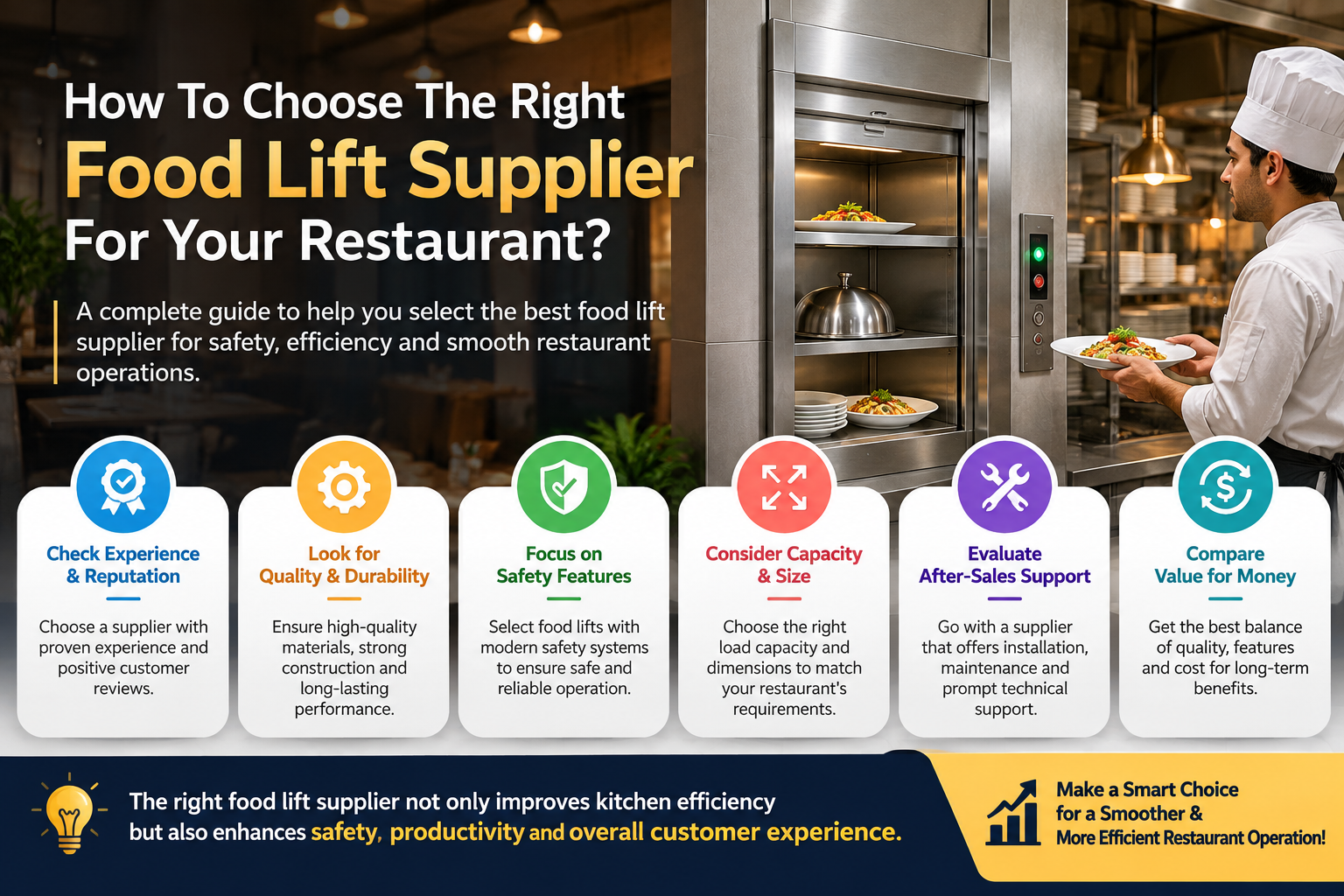
Choosing the right food lift supplier is an important decision for a restaurant. A food lift is not something you should select only by looking at the price, design, or advertised capacity. The supplier should understand what your restaurant needs to move, how often the lift will be used, how much space is available, how many floors need to be connected, and what kind of support you may need after installation.
A reliable supplier should make the buying process clear and straightforward. They should listen to your requirements, explain the available options, and help you choose a food lift that fits your actual application.
Mr.Dumbwaiter has 15+ years of experience in food lift and dumbwaiter solutions, with support for supply, installation, repair, replacement, and maintenance requirements. If you are planning a food lift for your restaurant, you can contact Mr.Dumbwaiter at +65 67344062 to discuss your requirements with the team.
What Should You Check Before Choosing A Food Lift Supplier?
The first step is to understand what you actually need from the food lift.
Before contacting a supplier, consider the type of goods you want to transport, their approximate weight and size, the number of floors involved, available installation space, and how frequently the equipment will operate.
A professional supplier should be willing to discuss these details with you rather than immediately offering a standard model.
Important points to discuss include:
- Required load capacity
- Cabin size
- Number of floors
- Travel distance
- Available shaft or installation space
- Door arrangement
- Daily usage
- Operating requirements
- Installation work
- Maintenance
- Repair support
- Replacement options
- Spare parts
- Overall project cost
The more clearly you explain your requirements, the easier it becomes for the supplier to recommend a suitable solution.
Why Is The Right Food Lift Important For A Restaurant?
Restaurants often need to move food, dishes, trays, ingredients, containers, and other supplies between different levels. Carrying these items manually through stairs can take additional staff time and may make internal movement less convenient.
A properly selected food lift gives the restaurant a dedicated way to move suitable goods between floors.
However, the benefit depends on choosing equipment that actually matches the restaurant's workflow.
A lift that is too small may make loading difficult. A system with insufficient capacity may not match the intended workload. A poorly planned installation can also create practical problems for staff.
This is why supplier selection should begin with your restaurant's requirements rather than with a product photograph or price.
How Do You Know What Food Lift Capacity Your Restaurant Needs?
Load capacity is one of the most important specifications to discuss with a supplier.
Start by identifying the heaviest normal load you expect to transport. Do not look only at the weight of one plate or one container. Consider the complete load, including trays, dishes, food containers, kitchen supplies, or other items that may be transported together.
You should also consider how the lift will be used during busy periods.
Ask yourself:
- What is the heaviest regular load?
- What items will normally be transported together?
- What is the largest tray or container?
- How frequently will the lift operate?
- Could the restaurant's requirements increase in the future?
A professional supplier can use this information to discuss an appropriate capacity rather than asking you to select one without understanding the application.
What Food Lift Size Should A Restaurant Choose?
Load capacity is only one part of the selection.
The internal cabin dimensions are equally important because the items must physically fit inside the lift.
Before choosing a supplier, think about:
- Cabin width
- Cabin depth
- Cabin height
- Door opening
- Tray dimensions
- Container size
- Largest item being transported
- Loading and unloading space
For example, a restaurant may need to move several trays together rather than individual items. In that situation, cabin dimensions become an important part of the buying decision.
The supplier should understand the size of the goods you plan to transport before suggesting a configuration.
Why Should You Check The Installation Space Before Ordering?
One of the biggest mistakes buyers can make is choosing the equipment before checking where it will be installed.
The available building space can affect the food lift configuration. The supplier may need information about the shaft or hoistway, landing positions, available access, floor levels, and other site conditions.
This becomes especially important when installing a lift in an existing restaurant.
Before placing an order, ask the supplier:
- What space is required?
- What shaft dimensions are needed?
- Where will the lift be positioned?
- How will each floor be accessed?
- What preparation is required?
- What electrical requirements need to be considered?
- What installation work is included?
Discussing these points early can help prevent unnecessary changes later.
How Important Is Food Lift Installation Support?
A food lift supplier should not only discuss the equipment. Installation should also be part of the conversation.
The installation process needs to match the equipment and the building conditions. Staff should also be able to use the lift comfortably as part of their normal restaurant workflow.
Ask whether the supplier can support the installation and explain what is included in the project.
A clear discussion should cover:
- Equipment supply
- Installation requirements
- Site preparation
- Landing arrangements
- Controls
- Testing
- Handover
- Future service
When these details are clear before the project begins, there is less room for confusion between the customer and supplier.
What Safety Points Should You Discuss With A Food Lift Supplier?
Safety should never be treated as an afterthought.
Before buying a food lift, ask the supplier to explain the safety provisions relevant to the proposed equipment and installation.
You can ask about:
- Door safety
- Door interlocks
- Operating controls
- Load-related protection
- Emergency arrangements
- Safe loading and unloading
- Maintenance access
- Applicable installation requirements
The supplier should explain these points clearly so that you understand how the equipment is intended to operate.
Do not assume that two food lifts are identical simply because they have similar external designs. The actual specification and configuration should be reviewed before making a decision.
Why Does Supplier Experience Matter?
Experience becomes particularly valuable when a restaurant has specific space, capacity, installation, or service requirements.
An experienced supplier should be able to discuss more than the product itself. They should understand the practical side of selecting, installing, maintaining, repairing, and replacing food lift equipment.
This can give restaurant owners greater confidence during the buying process.
Instead of asking only, “How much does the food lift cost?”, ask:
“Does this supplier understand what my restaurant actually needs?”
That question can lead to a much better discussion.
Why Choose Mr.Dumbwaiter For Your Restaurant Food Lift?
Choosing a food lift supplier is also about choosing a company you can communicate with and rely on throughout the project.
Mr.Dumbwaiter has 15+ years of experience in food lift and dumbwaiter solutions. The company supports requirements related to food lift supply, installation, repair, replacement, and maintenance.
The approach is simple: understand the customer's requirement first and then discuss a suitable solution.
Your restaurant may have its own load requirements, space limitations, floor layout, operating routine, and future plans. These details matter when selecting a food lift.
Mr.Dumbwaiter can discuss these requirements with you so that the decision is based on your actual application rather than simply choosing a standard option.
More Than Just A Food Lift Supplier
A good supplier relationship should not end when the equipment is delivered.
Restaurants may need installation assistance, servicing, repairs, replacement parts, or future equipment changes. Having a supplier you can communicate with when these needs arise can make the overall experience more convenient.
That is why commitment and communication matter.
Mr.Dumbwaiter focuses on building a long-term working relationship with customers by understanding their requirements and providing support around food lift and dumbwaiter needs.
When you contact the company, you can discuss your application, ask questions, explain your space limitations, and understand the options before making a final decision.
This gives you the confidence to move forward with a solution that is discussed around your actual requirements.
What Questions Should You Ask A Food Lift Supplier?
Before placing an order, ask the supplier direct questions.
1. What Capacity Do You Recommend?
Tell the supplier the normal and heaviest loads you expect to transport and ask why the proposed capacity is suitable.
2. What Cabin Size Do I Need?
Provide the dimensions of your largest trays, containers, dishes, or other goods so the cabin can be discussed around your actual requirements.
3. How Many Floors Can The Lift Serve?
Explain which levels need to be connected and ask about the required travel distance and landing arrangement.
4. What Installation Space Is Required?
Ask about shaft, cabin, door, landing, electrical, and access requirements before finalizing the equipment.
5. What Is Included In The Quotation?
Make sure you understand whether the quotation covers equipment, installation, testing, transportation, and other project requirements.
6. Do You Provide Repair And Maintenance?
Ask about service availability before buying. Future support should be part of your supplier evaluation.
7. What Happens If The Lift Needs Replacement?
Discuss the supplier's replacement support and how older equipment can be handled if your requirements change.
8. Can You Recommend A Solution Based On My Site?
A supplier should be able to discuss your actual building conditions rather than simply sending a generic specification.
How Should You Compare Food Lift Suppliers?
When comparing different suppliers, do not look at price alone.
Two quotations may appear similar but can include different equipment specifications, installation work, service coverage, or project requirements.
Compare:
- Load capacity
- Cabin dimensions
- Equipment configuration
- Number of floors
- Travel requirements
- Door arrangement
- Safety provisions
- Installation scope
- Maintenance support
- Repair service
- Replacement support
- Spare-part availability
- Warranty terms
- Total project cost
A clear comparison helps you understand what you are actually buying.
The lowest quotation is not automatically the most suitable choice. Your main question should be whether the proposed food lift meets the needs of your restaurant and whether the supplier can support you after the installation.
What Are The Common Mistakes When Choosing A Food Lift Supplier?
- Choosing Only On Price: Price matters, but it should be compared with the equipment specification and services included.
- Ignoring Cabin Dimensions: A lift can have suitable capacity but still be inconvenient if your regular trays or containers do not fit properly.
- Selecting Capacity Without Discussing Actual Loads: Your supplier should know what you intend to transport before recommending capacity.
- Forgetting About Installation: The available space and building conditions should be discussed before the equipment is finalized.
- Not Asking About Maintenance: A food lift is used as part of your restaurant operation. Ask how future servicing and repairs will be handled.
- Accepting An Unclear Quotation: If you do not understand what the quotation includes, ask the supplier to explain it before making a commitment.
- Choosing A Supplier That Stops Communicating After The Sale: A long-term supplier relationship is valuable because your requirements may continue after the initial installation.
How Can You Choose The Right Food Lift Supplier With Confidence?
The process becomes easier when you follow a clear order.
- First, define your application: Decide exactly what the lift will transport.
- Next, identify the load: Consider the maximum realistic weight rather than an average estimate.
- Then, check the dimensions: Measure the largest items that need to enter the cabin.
- Review the building: Consider available installation space, floors, landings, access, and other site conditions.
- Discuss installation: Understand what preparation and installation work will be required.
- Ask about service: Find out how repairs, maintenance, replacement, and spare parts will be handled.
- Compare complete quotations: Look at specifications and included services rather than price alone.
- Choose a supplier you trust to communicate clearly: You should feel comfortable asking questions and discussing your concerns before committing to the project.
Why A Long-Term Supplier Relationship Matters
A food lift is an investment in your restaurant's daily operation. Your relationship with the supplier may continue long after the initial installation.
You may later need:
- Maintenance
- Repairs
- Replacement components
- Equipment upgrades
- A replacement lift
- Advice for a new restaurant location
- Changes based on increased operational requirements
This is why choosing a supplier should be about more than completing one transaction.
Confidence comes from clear communication, proper understanding of your requirements, and knowing who you can contact when you need support.
Mr.Dumbwaiter aims to build that type of customer relationship by staying focused on the customer's actual food lift and dumbwaiter requirements.
Contact Mr.Dumbwaiter For Your Restaurant Food Lift Requirement
If you are planning a new food lift for your restaurant, replacing an existing system, or looking for food lift repair and maintenance support, start with a conversation about your actual requirements.
Share details such as:
- What you need to transport
- Approximate load
- Required cabin size
- Number of floors
- Available installation space
- Current lift condition, if it is a replacement or repair project
The more information you provide, the easier it is to discuss a suitable solution.
With 15+ years of experience, Mr.Dumbwaiter is ready to discuss your food lift requirement with a practical and customer-focused approach.
Call Mr.Dumbwaiter at +65 67344062 and discuss your restaurant food lift requirement with the team.
Conclusion
The right food lift supplier should offer more than equipment and a quotation. You need a supplier that understands your restaurant, listens to your requirements, explains the available options clearly, and remains available for installation, service, repair, maintenance, or replacement needs.
Before making your decision, check the capacity, cabin size, installation space, number of floors, safety requirements, quotation details, and after-sales support. These factors will help you make a more informed choice.
For restaurant owners who want to work with an experienced food lift and dumbwaiter company, Mr.Dumbwaiter offers 15+ years of experience and a commitment to customer support.
If you are ready to discuss your requirement, contact Mr.Dumbwaiter at +65 67344062. Share your restaurant's needs with the team, ask your questions, and take the next step with confidence.