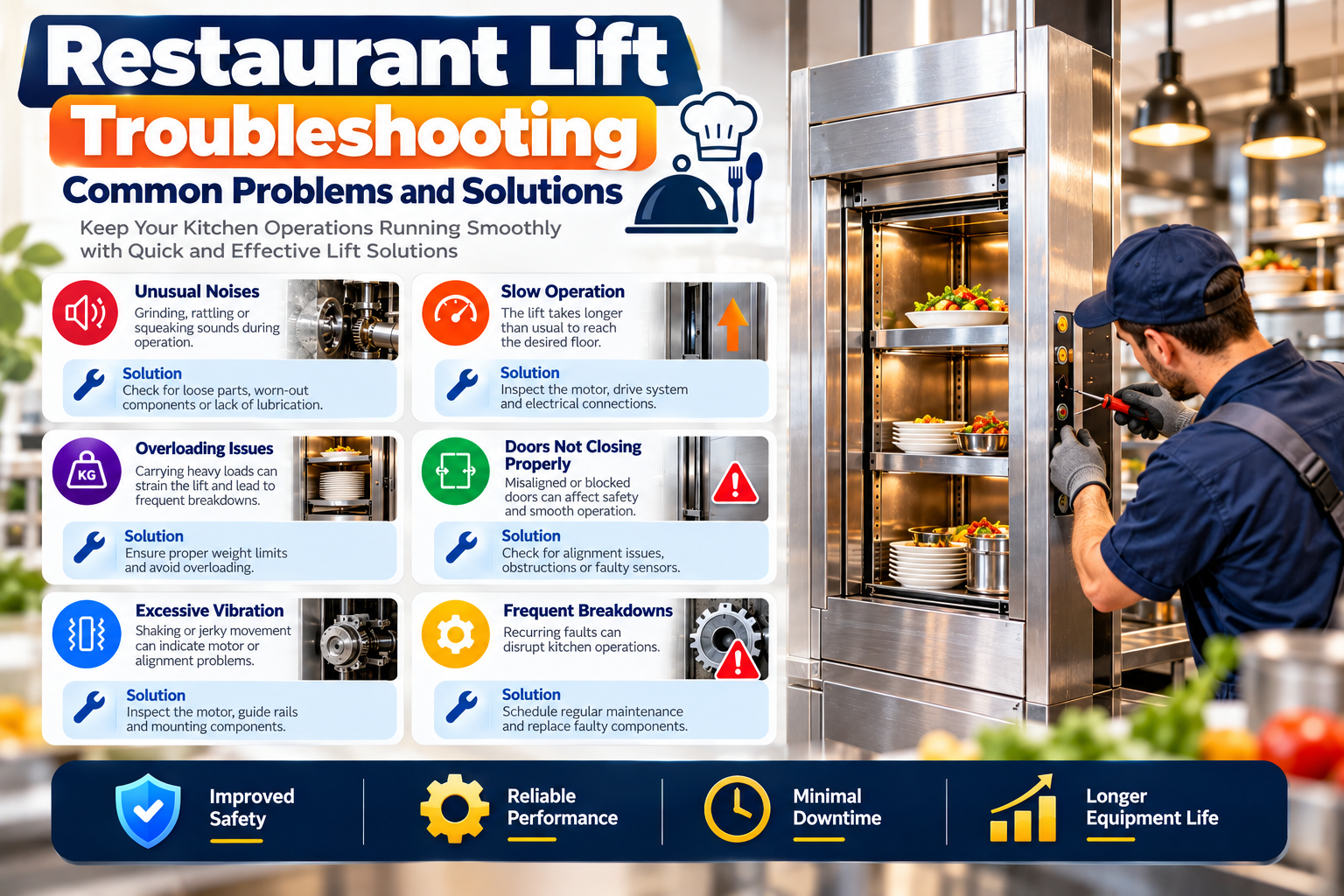
Restaurant lift troubleshooting starts by identifying what the lift is actually doing wrong. A food lift may stop moving, refuse to start, make an unusual sound, move unevenly, stop at the wrong level, or develop a door problem. Each symptom can have a different cause, so replacing parts without finding the actual fault can waste time and money.
A restaurant lift is used regularly to move food, dishes, kitchen supplies, trays, and other goods between levels. Because it may operate many times during a working day, even a small problem can interrupt kitchen and service operations.
The right approach is to identify the symptom, understand what could be causing it, and then have the relevant part inspected. Mr.Dumbwaiter has 15+ years of experience and can be contacted at +65 67344062 for restaurant lift service and repair support.
Why Does a Restaurant Lift Stop Working?
A restaurant lift can stop working because of a problem with its electrical system, controls, doors, safety system, motor, drive equipment, or mechanical components.
The important point is that a lift that does not move does not automatically have a motor problem.
For example, if a door is not properly secured, the lift may remain stationary because its operating system is preventing movement. Similarly, a control fault can stop the lift even when the mechanical parts are still in usable condition.
Before deciding what needs to be repaired, consider:
- Does the lift have power?
- Are the operating controls responding?
- Are the doors closing normally?
- Does the problem happen at one level or all levels?
- Did the lift make a new sound before stopping?
- Does the problem happen every time or only occasionally?
- Was the lift carrying a heavy load when the problem occurred?
These observations can help narrow down the problem.
Restaurant Lift Does Not Start or Move
One of the most common complaints is that the lift does nothing after a call button is pressed.
The first thing to understand is whether the problem is complete loss of operation or whether only one control point is affected.
If the lift has no response at all, the issue could involve the power supply, controls, safety circuit, or another part of the operating system. If the lift responds at one level but not another, the problem may be connected to a particular control point or door condition.
Do not open electrical panels or attempt to change internal wiring simply because the lift is not moving. Electrical troubleshooting should be handled by a suitably qualified professional.
If the lift starts working again after being switched off and restarted, do not automatically assume the problem has disappeared. A recurring fault should still be investigated.
Restaurant Lift Door Is Not Closing Properly
Door problems can prevent a restaurant lift from operating normally.
A door may become difficult to close, stop before reaching its normal position, reopen unexpectedly, or require unusual pressure to close. Dirt, food residue, physical wear, alignment problems, damaged components, or a problem with the door safety system may be involved.
The door is not just an opening for loading goods. Its correct operation can also be connected to the lift's safety and control system.
If the lift only operates when someone pushes or holds the door in a particular position, that should not be treated as normal.
Never bypass a door safety mechanism just to make the lift operate.
A door that does not behave normally should be inspected and corrected before the equipment is returned to regular service.
Restaurant Lift Stops Between Floors
A lift stopping before reaching its intended level needs careful attention.
Do not try to pull the lift manually, force a door open, or interfere with internal equipment to move it to another level. A lift that has stopped unexpectedly may have a control, electrical, mechanical, position-related, or safety-system problem.
The useful information to record is:
- Where the lift stopped.
- Whether it was travelling upward or downward.
- Whether it was carrying a load.
- Whether the controls still responded.
- Whether any unusual sound occurred.
- Whether the same problem has happened before.
This information can help a technician trace the fault more efficiently.
If the lift has stopped in an unsafe position or there is visible damage, unusual heat, smoke, or a burning smell, keep people away from the equipment and arrange professional assistance.
Why Is My Restaurant Lift Making Strange Noises?
A restaurant lift can produce different sounds when something changes in its operation.
You may notice:
- Rattling
- Clicking
- Scraping
- Grinding
- Knocking
- Repeated vibration
- A louder-than-normal motor sound
The sound itself does not identify the exact failed component. What matters is when the sound happens.
For example, does it happen when the lift starts, while travelling, when it stops, or while a door is moving?
A new sound can indicate that a moving or supporting component needs attention. Continuing to use the lift without investigating a noticeable change can make it harder to know when the problem first started.
If the sound is new, repeated, or becoming louder, professional inspection is a sensible next step.
Restaurant Lift Moves Slowly or Unevenly
A food lift should operate in a predictable manner. If it suddenly becomes slow, jerky, shaky, or uneven, the change should be investigated.
Possible areas requiring inspection can include the drive system, motor, controls, moving components, alignment, or other mechanical parts.
The pattern of the problem can provide useful information.
If the lift is slow during every trip, the cause may be different from a lift that becomes slow only after repeated operation. Likewise, a problem that appears only when carrying a particular load may need to be assessed differently from one that occurs when the lift is empty.
Do not try to compensate for unusual movement by repeatedly operating the controls. Record what is happening and have the equipment checked.
Why Does the Restaurant Lift Stop at the Wrong Level?
A restaurant lift that does not reach its normal stopping position can create a practical problem when staff are loading or unloading goods.
The issue may involve the system that controls movement and stopping, a position-related component, mechanical wear, or another part of the lift's operating system.
If the lift consistently stops too high, too low, or at an unusual position, that behaviour should be reported.
A small change in stopping position can be easy to ignore because the lift may continue working. However, changes in normal operation are useful warning signs and should not be treated as something staff must simply work around.
Why Are Restaurant Lift Buttons Not Responding?
Sometimes the lift itself is operational but a particular button does not respond.
The fault may be limited to the control point, or it may be connected to wiring, controls, or another part of the operating system.
A useful observation is whether:
- One button has stopped working.
- Several buttons have stopped working.
- The lift works from another level.
- The problem happens every time.
- The button works only occasionally.
These details help distinguish a local control problem from a wider operating fault.
Do not repeatedly press a faulty button or dismantle the control panel. A qualified technician can test the control system and determine what actually needs attention.
What Should You Check Before Calling for Restaurant Lift Repair?
You do not need to dismantle a restaurant lift to provide useful troubleshooting information.
Before contacting a repair professional, note the basic symptoms:
- What exactly happened?
- When did the problem begin?
- Was the lift working normally before that?
- Does it happen every time?
- Which floor is affected?
- Is the door closing normally?
- Is there an unusual noise?
- Is the lift moving differently?
- Does the problem happen with or without a load?
- Are there any visible warning indications?
Also tell the technician whether the problem is getting worse, staying the same, or appearing only occasionally.
This information can save time because the technician arrives with a clearer understanding of the reported problem.
Which Restaurant Lift Problems Need Immediate Attention?
Some problems should not be treated as minor operating inconveniences.
Arrange professional attention when the lift:
- Stops unexpectedly during travel.
- Develops unusual or worsening movement.
- Makes a new mechanical sound.
- Has a door that will not close or secure correctly.
- Repeatedly stops working.
- Shows signs of electrical damage.
- Produces smoke or a burning smell.
- Has a recurring fault after restarting.
- Stops accurately only sometimes.
- Behaves differently when carrying goods.
A restaurant may depend heavily on its food lift, but keeping a faulty lift running simply to avoid disruption can create a bigger problem.
The safer approach is to identify the fault and determine whether the equipment is suitable for continued operation.
Can a Restaurant Lift Problem Be Repaired?
Yes, many restaurant lift problems can be addressed without replacing the complete lift, but the correct solution depends on the condition of the equipment.
A technician may find that the issue is related to one component, an adjustment, alignment, wiring, controls, a door mechanism, or another part of the system.
In other situations, repeated faults may indicate that several components have become worn or that the equipment needs a larger repair or upgrade.
That is why it is better to inspect the lift before deciding between repair and replacement.
A proper assessment should answer three basic questions:
What has failed?
Identify the actual fault rather than treating only the visible symptom.
Can the affected part be repaired or replaced?
The condition and compatibility of the component need to be considered.
Is continued repair practical?
If the equipment has repeated failures or significant overall wear, a larger solution may need to be considered.
How Can Restaurant Lift Problems Be Reduced?
Regular attention can help identify problems before they become major operating interruptions.
Restaurant staff should report small changes instead of waiting for a complete breakdown. A door that suddenly behaves differently, unusual movement, a new sound, or repeated stopping can all provide useful information.
Good operating habits also matter. Staff should use the lift according to its intended purpose and capacity, avoid forcing doors, and report damage rather than continuing to operate the equipment as if nothing happened.
Maintenance should also be based on the particular lift, its design, operating conditions, and manufacturer's requirements.
The goal is not to eliminate every possible fault. The goal is to identify developing problems early and keep the equipment in suitable operating condition.
How Does Professional Restaurant Lift Troubleshooting Work?
Professional troubleshooting should follow the symptom instead of guessing the replacement part.
A typical assessment starts by understanding the reported problem. The relevant controls, doors, electrical systems, movement, mechanical components, and other applicable parts can then be examined according to the equipment design.
The technician may need to determine:
- What triggers the fault.
- Which part of the operation is affected.
- Whether the problem is constant or intermittent.
- Whether the fault is electrical, mechanical, control-related, or connected with another system.
- Whether a component needs adjustment, repair, or replacement.
- Whether the lift operates correctly after the repair.
This method helps avoid replacing a component simply because it appears to be connected with the symptom.
The final repair should be based on the actual condition of the restaurant lift.
When Should You Contact Mr.Dumbwaiter?
If your restaurant lift is not operating normally and you are unsure what is causing the problem, getting the equipment assessed is better than repeatedly resetting it or attempting an internal repair yourself.
Mr.Dumbwaiter has 15+ years of experience and provides support for dumbwaiter and restaurant lift requirements.
When contacting the team, explain the problem as clearly as possible. Mention the lift behaviour, the affected floor, any unusual sound, door problem, repeated fault, or other change you have noticed.
You can contact Mr.Dumbwaiter at +65 67344062 to discuss the restaurant lift problem and the appropriate next step.
Conclusion
Restaurant lift troubleshooting is easier when the symptom is clearly identified before any repair is attempted. A lift that does not move may have a control, door, electrical, mechanical, or safety-related problem. Unusual noise, uneven movement, inaccurate stopping, repeated shutdowns, and door faults can also indicate that the equipment needs attention.
Do not bypass safety systems or attempt internal repairs without the proper technical knowledge and qualifications. Instead, record what the lift is doing, stop using it when its operation appears unsafe or abnormal, and arrange a proper inspection.
The right repair depends on the actual cause. A careful diagnosis can determine whether the solution is an adjustment, repair, component replacement, upgrade, or a larger replacement decision.
For restaurant lift troubleshooting and repair support, Mr.Dumbwaiter can be contacted at +65 67344062.