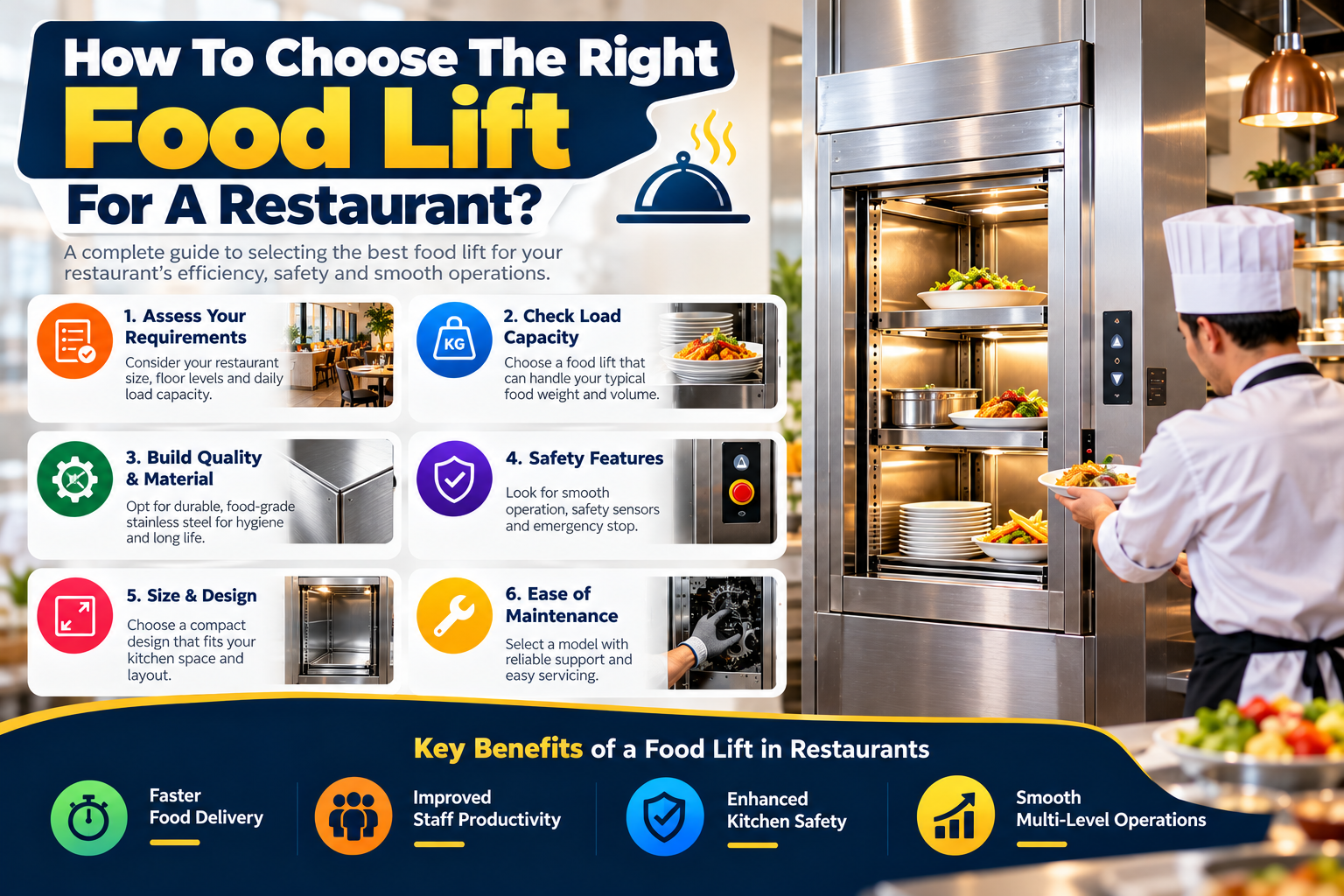
Choosing a food lift for a restaurant should start with the way the kitchen actually works. The right system needs to accommodate the food, trays, containers, and supplies being moved while fitting the building and the restaurant's daily operating pattern.
A food lift that is too small can create extra trips. One that is unnecessarily large can take more space than needed. The practical choice comes from matching the lift to the restaurant's load, cabin requirements, floor arrangement, available space, usage frequency, and installation needs.
Mr.Dumbwaiter has 15+ years of experience helping with dumbwaiter and food lift requirements. For project discussions, you can contact the team at +65 67344062.
Decide What The Lift Will Actually Move
Before looking at models, make a list of everything the restaurant expects to send through the lift.
Depending on the kitchen layout, this could include:
- Prepared meals
- Plates and serving dishes
- Food trays
- Ingredients
- Beverage containers
- Kitchen utensils
- Packaged supplies
- Small kitchen items
The list matters because different goods can require different amounts of cabin space.
For example, a restaurant that mainly moves plates may need a different internal arrangement from a kitchen that regularly moves deep food containers or boxes of supplies.
Do not start by asking, "Which food lift is the biggest?" Start by asking, "What exactly will go inside it?"
That simple change in the selection process can prevent many problems later.
Work Out The Real Load Requirement
The lift's rated capacity should be based on the actual load that staff will place inside the cabin.
Do not calculate the requirement from the food alone. Include the weight of the items used to transport it.
For example, the complete load may include:
- Food
- Plates
- Trays
- Containers
- Serving equipment
- Packaging
- Other goods being transported together
Now identify the heaviest normal load rather than relying only on an average trip.
It is also useful to consider whether the restaurant expects its operation to change. A kitchen that currently moves light meals may later need to transport heavier supplies.
The goal is not to choose the maximum possible capacity. The goal is to select a capacity that suits the real operating requirement without encouraging loads beyond the rated limit.
Measure The Largest Item Before Choosing Cabin Size
Weight is only half of the sizing decision.
A container can be light enough for the lift but still fail to fit through the door or inside the cabin.
Measure the largest items that need to travel through the lift, including:
- Tray width
- Tray length
- Container width
- Container depth
- Item height
- Stacked height
- Quantity carried in one trip
Then compare these measurements with the proposed cabin's usable internal dimensions.
Pay particular attention to the door opening. A cabin may appear large enough on paper, but a restricted opening can make loading difficult.
Leave enough practical room for staff to place and remove items without constantly rearranging the load.
Match The Food Lift To The Kitchen Workflow
The location of the food lift can be just as important as its technical specification.
Think about the complete movement:
Where is the item prepared → where is it loaded → which level receives it → where is it unloaded?
The lift should support this path with as little unnecessary movement as possible.
For example, if kitchen staff have to carry prepared food across a crowded service area before reaching the lift, the equipment may not solve the real workflow problem.
Look at:
- Kitchen entrance and exit points
- Preparation areas
- Storage areas
- Dining areas
- Service counters
- Loading positions
- Receiving positions
- Staff walking routes
A good food lift should become part of the restaurant's working process rather than an isolated piece of equipment.
Consider How Often The Lift Will Be Used
A restaurant that uses its food lift a few times a day has a different operational requirement from one that depends on it continuously during service.
Think about the busiest part of the working day.
Ask:
- How many trips may be required?
- How many items are normally moved per trip?
- How long does loading take?
- How long does unloading take?
- How many floors are involved?
- Will several staff members depend on the lift?
This helps determine whether the proposed setup can support the restaurant's actual pace.
A lift does not improve workflow simply because it travels between floors. The entire loading, travelling, and unloading process needs to work together.
Check The Number Of Floors And Travel Distance
Next, identify every floor that the food lift needs to serve.
Do not provide only a general building height. Specify the actual levels where staff need access.
For example, the project may involve movement between:
- A kitchen and dining floor
- A preparation area and service floor
- Storage and kitchen areas
- Multiple restaurant levels
The number of stops and the distance between them affect the overall configuration.
Also consider whether every proposed stop will genuinely be used. Adding unnecessary stops can complicate a project without providing a useful operational benefit.
Check The Available Installation Space
Before selecting a food lift, measure the building.
Important measurements include:
- Available shaft or hoistway area
- Cabin space
- Door area
- Landing space
- Vertical travel
- Space above the highest stop
- Space below the lowest stop
- Access for installation
- Space required for servicing
This becomes especially important when adding a food lift to an existing restaurant.
New construction usually provides more flexibility. An existing building may have walls, beams, floors, pipes, electrical systems, kitchen equipment, and other restrictions that affect where the lift can be placed.
A site assessment can therefore be more useful than choosing equipment from a product picture alone.
Think About The Door Arrangement
The door is part of the working process.
Staff should be able to load and remove the goods in a practical manner at every required level.
When considering the door arrangement, check:
- Available landing space
- Direction of staff movement
- Size of the goods
- Loading height
- Position of the lift
- Access at each stop
The selected arrangement should also include the appropriate safety provisions for the equipment and installation.
Do not assume that one door configuration will suit every restaurant. The correct arrangement depends on the building and the way the lift will be used.
Choose A Cabin That Makes Cleaning Practical
Food-service equipment needs regular cleaning.
When comparing food lift options, look beyond appearance and consider how easily staff can maintain the cabin during normal operations.
Useful questions include:
- Are the internal surfaces easy to wipe?
- Can staff reach the important areas?
- Are there awkward spaces where food residue can collect?
- Is the interior suitable for the restaurant's cleaning routine?
- Can routine inspection and maintenance be carried out without creating unnecessary disruption?
The cabin material and finish should be selected according to the operating environment and the manufacturer's specifications.
The important point is simple: cleaning should be part of the design decision, not an afterthought.
Consider Noise During Restaurant Operations
Noise can matter in a restaurant, particularly when the lift is located close to dining or customer-facing areas.
Consider where the equipment will operate and when it will be used.
If the lift is positioned near a dining space, hotel-style service area, or another location where noise matters, discuss the operating characteristics with the supplier before making the final selection.
Do not judge noise only from a product description. The building, installation, equipment configuration, and surrounding environment can all affect how the system is experienced.
Check Safety And Operating Requirements
A food lift should be selected with safety requirements in mind from the beginning.
The exact requirements depend on the equipment, building, installation, and applicable rules in the place where the lift will be installed.
Ask the supplier to explain:
- How the lift is operated
- How access is controlled
- What safety interlocks are provided
- What happens at each landing
- What operating limitations apply
- What inspection or maintenance arrangements are required
- What the building needs to provide before installation
A food lift should be used only for the purpose for which it has been designed and rated.
Do not assume that a food lift can be used to transport people simply because a person can physically enter the cabin. Equipment intended for goods transport should be operated according to its specified use.
Think About Future Restaurant Requirements
The best choice should make sense not only for today's operation but also for realistic future use.
Restaurants can change their menu, kitchen arrangement, storage requirements, service model, or number of operating floors.
Before finalizing the specification, ask:
Could the restaurant reasonably need more capacity or different goods in the future?
That does not mean buying the largest system available. It means avoiding a specification that is so restrictive that a predictable change would make the equipment unsuitable.
Future requirements should be discussed with the supplier before the equipment is ordered.
Compare Complete Specifications Instead Of Just Prices
Price is important, but it should not be the first or only comparison.
Two food lift quotations may have very different specifications even if both are described using similar product names.
When comparing proposals, place the important details side by side:
|
Requirement |
What To Check |
|
Capacity |
Rated load for the intended application |
|
Cabin |
Internal width, depth and height |
|
Door |
Opening size and arrangement |
|
Floors |
Number of required stops |
|
Travel |
Distance between required levels |
|
Installation |
Building preparation and installation scope |
|
Controls |
Operating arrangement |
|
Safety |
Applicable safety provisions |
|
Maintenance |
Routine servicing requirements |
|
Support |
Repair and replacement assistance |
|
Warranty |
What the supplier actually covers |
This makes it easier to understand what you are paying for.
A low quotation may not remain low if important installation work, building preparation, accessories, or service requirements are excluded.
Ask The Supplier For A Site-Specific Recommendation
Once the basic information is ready, give it to the food lift supplier.
A useful project enquiry should include:
- What the lift will carry
- Heaviest normal load
- Largest item dimensions
- Number of items per trip
- Number of floors
- Approximate travel distance
- Available installation space
- Preferred loading points
- Expected usage frequency
- Any known building restrictions
The supplier can then assess the requirement instead of recommending equipment from a single keyword such as "restaurant food lift."
This also makes the quotation more meaningful because the supplier understands what the equipment is expected to do.
Common Food Lift Selection Mistakes To Avoid
Choosing by capacity alone: A suitable weight rating does not guarantee that the cabin will accommodate the required goods.
Ignoring door dimensions: The item must pass through the opening, not just fit inside the cabin.
Using average loads: Peak operating loads should also be considered.
Forgetting the staff workflow: A badly positioned lift can create extra walking even when the equipment itself works correctly.
Selecting equipment before measuring the building: Available shaft and landing space can restrict the possible configuration.
Comparing only purchase prices: Installation and ongoing support can affect the overall project.
Ignoring maintenance: The restaurant should know what routine service the equipment requires before purchasing.
Assuming every food lift is the same: Capacity, dimensions, travel, doors, controls, and installation conditions can vary between projects.
A Practical Checklist Before You Order
Before approving a food lift, make sure you can answer these questions:
- What exactly will the lift transport?
- What is the heaviest normal load?
- What is the largest item?
- What cabin dimensions are required?
- What door opening is needed?
- How many floors must be served?
- What is the required travel distance?
- How frequently will the lift operate?
- Where will loading and unloading happen?
- How much installation space is available?
- What building preparation is required?
- What safety requirements apply?
- How will the equipment be maintained?
- What support is available after installation?
- Can the selected specification handle realistic future requirements?
If these answers are clear, the supplier has a much better foundation for recommending an appropriate system.
How Mr.Dumbwaiter Can Help With Food Lift Selection
Choosing a food lift is easier when the requirement is assessed before the equipment is finalized.
Mr.Dumbwaiter has 15+ years of experience and can discuss the intended application, load requirements, cabin needs, floor arrangement, and installation conditions with the customer.
If you already know the basic requirements, you can contact Mr.Dumbwaiter at +65 67344062 to discuss the project and determine what information is needed for the next step.
Conclusion
The right food lift for a restaurant is not simply the largest, fastest, or cheapest option. It should fit the actual goods being transported, the required load, cabin dimensions, door arrangement, number of floors, available building space, staff workflow, usage pattern, and maintenance needs.
Start by measuring the goods and understanding the busiest part of the restaurant's operation. Then assess the building and compare complete specifications rather than comparing prices alone.
A careful selection process before installation can make the food lift more practical for everyday restaurant work and help avoid problems caused by choosing equipment without first understanding the real requirement.