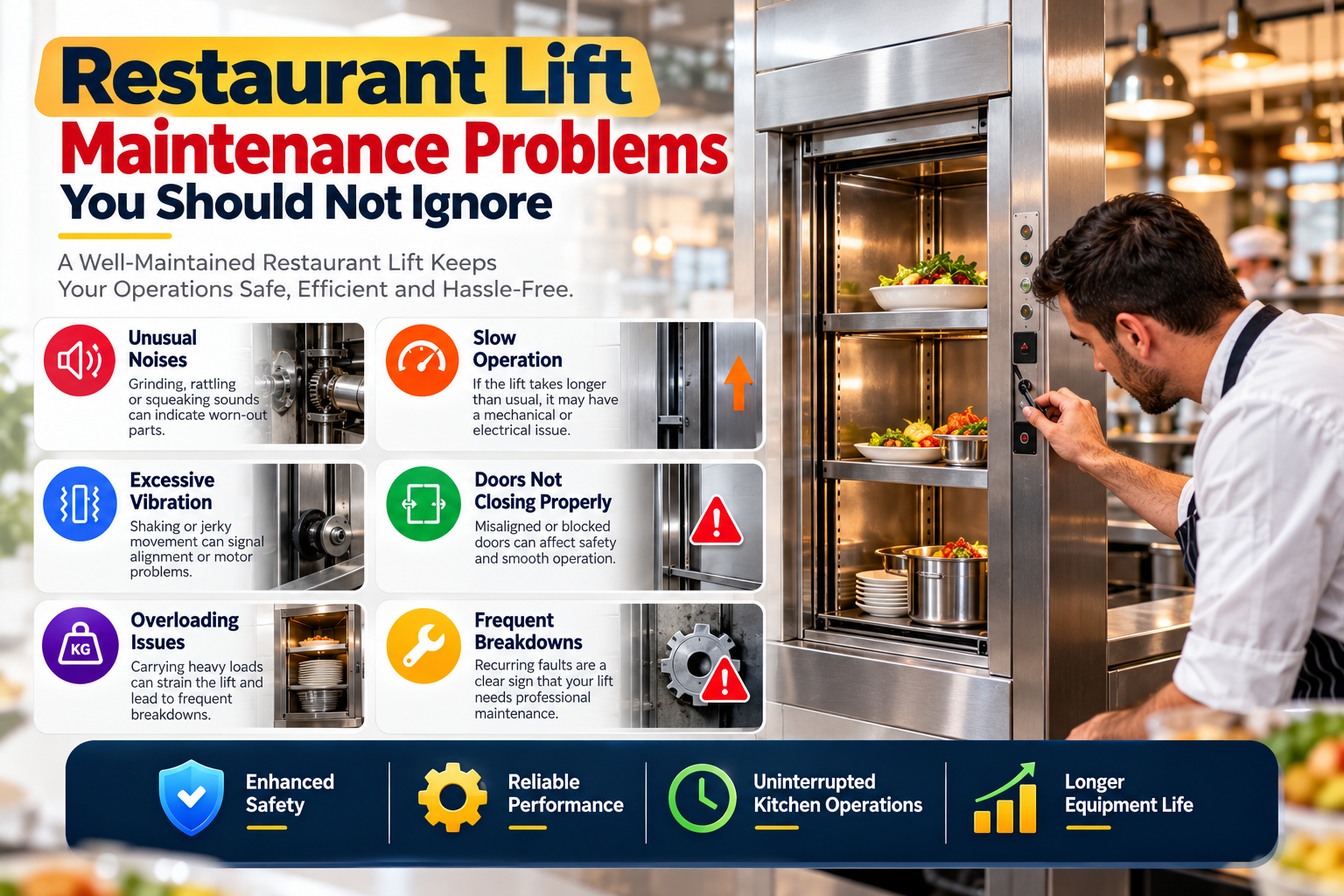
Restaurant lifts, food lifts, and dumbwaiters often operate many times during a working day. They move food, dishes, ingredients, supplies, and other goods between floors, so even a small mechanical or electrical problem can affect kitchen and restaurant operations.
The most important maintenance problems are usually easy to notice: unusual sounds, slow movement, jerking, door faults, uneven stopping, repeated breakdowns, control problems, overheating, or sudden stops. These signs should not be ignored because a lift that is still moving can already have a component that needs attention.
Regular maintenance helps identify wear and faults before they become larger problems. For restaurant owners and managers, the practical goal is simple: keep the lift reliable, address unusual changes early, and never bypass a safety device to keep the equipment running.
Unusual Noise Coming From the Restaurant Lift
A change in the normal sound of a restaurant lift is worth checking.
Grinding, scraping, knocking, rattling, squeaking, or repeated clicking can indicate wear, loose components, friction, alignment issues, or another mechanical problem. The exact cause depends on the lift design and the component producing the sound.
A useful approach is to notice when the sound occurs. Does it happen while the lift starts, while it travels, when it stops, or when the door opens and closes?
That information can help a technician narrow down the problem.
Do not assume that adding lubricant will solve every unusual noise. Some components require adjustment, replacement, alignment, or a more detailed inspection.
Slow Movement Can Be an Early Warning Sign
A restaurant lift that has become noticeably slower than normal may need maintenance.
The cause could involve the motor, drive system, mechanical resistance, electrical controls, or worn moving components. A gradual speed change is particularly easy to overlook because the lift may still complete its journey.
Compare the current operation with the lift's normal performance rather than judging it only by whether it still works.
If the lift takes longer to start, travels differently under load, or repeatedly slows at the same point, record the symptom and arrange an inspection.
Jerking, Shaking, or Uneven Movement
A properly maintained lift should operate in a controlled manner appropriate to its design.
Jerking or shaking during travel can be associated with guide components, drive parts, mechanical wear, control problems, or other faults. Excessive vibration may also place additional stress on components over time.
This problem should not be treated as normal simply because the lift eventually reaches the required floor.
Pay attention to whether the movement happens:
- During starting
- During acceleration
- While travelling
- Near a landing
- During stopping
- Only when carrying a heavier load
A clear description of the symptom gives the maintenance technician useful information before inspection begins.
Restaurant Lift Doors Are Not Closing Correctly
Door problems are among the maintenance issues that should receive prompt attention.
A landing door that sticks, remains partly open, closes inconsistently, or does not lock correctly can affect the safe operation of the lift.
Door interlocks are particularly important. They are designed as part of the safety system so that the lift does not operate when the required door condition has not been met.
Never bypass an interlock, switch, sensor, or other safety component simply to keep the restaurant lift operating. If a safety device is malfunctioning, the equipment should be inspected by a suitably qualified professional.
The Lift Stops Suddenly or Gets Stuck
Unexpected stopping is another problem that should not be ignored.
A lift may stop because of an electrical fault, control issue, sensor, switch, motor problem, mechanical obstruction, or another component failure. The visible symptom does not always identify the actual cause.
If the lift stops repeatedly, record:
- Which floor it stopped at
- Whether it was loaded
- Whether the doors were open or closed
- Whether an error appeared
- Whether the problem occurs during upward or downward travel
- Whether resetting temporarily restores operation
Do not force the lift, pull on its doors, or attempt improvised repairs. Incorrect handling can turn a manageable fault into a more complicated repair.
The Restaurant Lift Is Not Stopping Level With the Landing
Levelling is another performance issue that deserves attention.
If the lift stops noticeably above or below the intended landing position, loading and unloading goods can become more difficult. It may also indicate a problem with the drive, brake, control system, position-related components, or another part of the equipment.
A change in levelling should be reported even when the difference appears small.
The important point is whether the lift's current stopping position is different from its normal operation. A technician can then determine whether adjustment, component repair, or further investigation is required.
Buttons and Controls Are Becoming Unreliable
Control problems often begin as intermittent faults.
A call button may work only after several attempts. A control may respond slowly. The lift may fail to respond at one landing but work normally from another. Repeated resets may temporarily restore operation.
These symptoms can involve switches, wiring, sensors, control boards, contactors, or other electrical components.
Instead of repeatedly resetting the system, record the fault and arrange an inspection if it continues.
Repeated electrical faults can provide useful clues about a developing problem, especially when they occur under the same operating conditions.
Repeated Error Messages Should Not Be Ignored
If a restaurant lift has a display or controller that produces error codes, do not simply clear the message every time it appears.
Write down the code, the time it occurred, and what the lift was doing immediately beforehand.
For example, a fault that appears only when the lift starts moving may provide different diagnostic information from one that appears when the lift reaches a landing.
A maintenance professional can use this information together with an inspection of the electrical and mechanical systems to identify the likely cause.
The Motor Is Overheating or Producing an Unusual Smell
Unusual heat from the motor or a burning smell requires attention.
Overheating may be associated with excessive mechanical resistance, electrical faults, operating conditions, poor cooling, or component wear. The correct cause cannot be determined simply by touching the motor housing or listening to it.
If you notice smoke, a strong burning smell, visible electrical damage, or repeated motor shutdowns, stop normal operation and arrange professional assistance.
Do not continue restarting equipment that repeatedly overheats.
The Lift Requires Repairs More Often
Frequent breakdowns can indicate that the equipment needs more than another isolated repair.
If the same problem returns repeatedly, the underlying cause should be investigated. Simply replacing a part without understanding why it failed may not prevent the problem from returning.
Keep a maintenance record showing:
- Date of each fault
- Description of the problem
- Error codes
- Parts repaired or replaced
- Date of servicing
- Recurring symptoms
- Any changes in lift performance
A repair history helps a technician identify patterns and can make future maintenance more targeted.
Food, Grease, and Debris Can Affect Lift Performance
Restaurant environments create maintenance challenges that may not be present in other applications.
Food particles, grease, moisture, dust, and other debris can accumulate around accessible areas of equipment. Poor cleanliness can contribute to sticking doors, contaminated components, unpleasant smells, and other operating problems.
Cleaning should follow the manufacturer's instructions and should not involve applying liquids or cleaning products to electrical components where they are not intended to be used.
The lift should also be kept free from unnecessary objects that could interfere with doors, landings, or normal movement.
Overloading Can Create Maintenance Problems
Restaurant lifts are designed for a specified load capacity. Regularly carrying loads beyond the rated capacity can place additional stress on the lifting system and other components.
Staff should know the permitted load and should distribute goods appropriately.
Do not judge capacity by whether the lift can physically move with a heavier load. A lift moving under excessive load does not mean that the equipment is being used correctly.
If the restaurant's daily requirements have changed and the lift is regularly being asked to carry heavier or different loads, discuss the situation with a qualified lift professional.
Why Preventive Restaurant Lift Maintenance Matters
Maintenance should not begin only after a breakdown.
Preventive maintenance allows important components to be inspected and serviced according to the equipment design, manufacturer's requirements, usage, and applicable safety requirements.
Depending on the system, maintenance may include inspection of:
- Motor and drive components
- Cables, chains, or other suspension components
- Guide systems
- Doors and door mechanisms
- Interlocks and safety switches
- Controls and electrical connections
- Limit and position devices
- Braking components
- Landing areas
- General operating condition
The exact maintenance tasks and intervals should be determined for the particular lift rather than applying one schedule to every system.
What Should You Do When a Restaurant Lift Develops a Problem?
Start by identifying the change in normal operation.
Do not dismantle the equipment or attempt to repair electrical, mechanical, or safety components without the required technical knowledge.
If the problem involves abnormal movement, repeated stopping, door or interlock faults, electrical problems, overheating, or another safety-related issue, stop using the equipment when appropriate and arrange a professional inspection.
Before calling a technician, collect useful information:
- What exactly is the lift doing?
- When did the problem start?
- Does it happen every time?
- Does it happen with or without a load?
- Is there an error code?
- Has the lift recently been serviced or repaired?
- Is there an unusual noise, smell, or vibration?
These details can make diagnosis more efficient.
When Does a Restaurant Lift Need Repair Instead of Routine Maintenance?
Routine maintenance and repair are not always the same thing.
Maintenance is normally planned to inspect, clean, adjust, lubricate where appropriate, test, and monitor equipment. Repair is needed when a component has developed a fault or is no longer performing as intended.
For example, a scheduled inspection may identify wear before a component fails. On the other hand, a lift that suddenly stops, develops a serious door fault, or repeatedly loses control function may require repair rather than simply waiting for the next routine service.
The correct action depends on the condition of the equipment and the specific fault.
Restaurant Lift Maintenance and Repair by Mr.Dumbwaiter
Mr.Dumbwaiter provides restaurant lift and dumbwaiter services including maintenance, repair, installation, upgrades, and spare parts support.
With 15+ years of experience, Mr.Dumbwaiter works with lift-related requirements where reliable operation and proper maintenance are important.
If your restaurant lift is making unusual sounds, moving differently, stopping unexpectedly, developing door problems, or requiring repeated repairs, you can contact Mr.Dumbwaiter at +65 67344062 to discuss the issue and determine the appropriate next step.
A technician can assess the equipment, identify the reported problem, and explain whether the situation calls for maintenance, repair, replacement of a component, or further inspection.
Conclusion
Restaurant lift maintenance problems should not be ignored simply because the equipment is still operating.
Unusual noise, slow movement, jerking, door faults, sudden stops, poor levelling, unreliable controls, error messages, overheating, overloading, and repeated breakdowns can all be reasons to investigate the equipment.
The best time to address a developing problem is before it becomes a complete operational failure. Keeping maintenance records, following the manufacturer's requirements, using the lift within its rated capacity, and arranging professional inspection when performance changes can help reduce avoidable problems.
For restaurants that depend on a food lift or dumbwaiter throughout the working day, consistent maintenance is not just about keeping the equipment moving. It is about identifying faults early, protecting important components, and keeping the system operating as intended.